
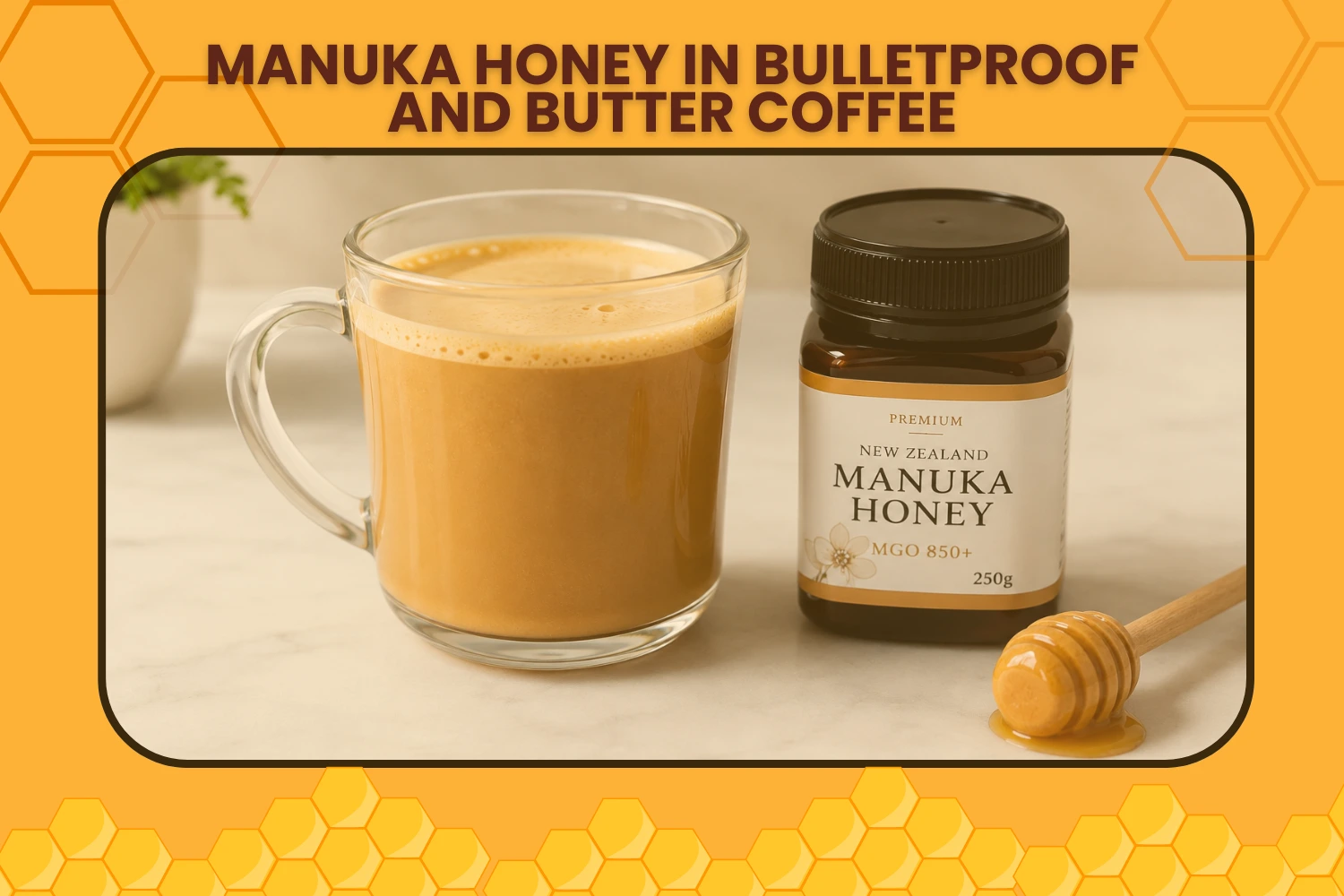
Adding Manuka honey to bulletproof or butter coffee can improve the drink’s flavor, but butter and MCT oil have not been shown to protect the honey’s methylglyoxal (MGO) from heat. The better-supported variables are temperature, exposure time, dilution, and the honey’s composition—not whether the coffee contains fat.
However, no direct study has established exactly how MGO behaves in a butter- or MCT-containing coffee emulsion. The conclusions below should therefore be understood as evidence-based guidance rather than a definitive laboratory rule.
Why Add Manuka Honey to Bulletproof Coffee?
Bulletproof and butter coffee are usually made with coffee, butter, ghee, MCT oil, or another fat. Unlike regular sweetened coffee, they are generally designed to be rich and creamy rather than sweet.

Adding a small amount of Manuka honey is a deliberate choice. Some people use it because the sweetness balances the heavy, savory flavor of butter or MCT oil. Others already add honey to tea or regular coffee and want to know whether the same habit works in a high-fat drink.
The combination is also a reasonable question from a food-science perspective. Both heat and fat are present in bulletproof coffee, so it is natural to wonder whether the fat changes how Manuka honey behaves.
The short answer is that there is currently no good evidence showing that butter, ghee, or MCT oil shields MGO from heat. Fat may change the drink’s texture and flavor, but it has not been demonstrated to preserve MGO.
Butter and MCT oil are also different ingredients. Butter is a dairy fat containing milk solids and water, while MCT oil is a concentrated oil made primarily from medium-chain triglycerides. These differences affect texture, flavor, and blending, but they do not create a known reason to use a different Manuka honey grade.
Does Fat Protect Manuka Honey’s MGO?
There is no direct evidence that butter or MCT oil protects MGO from heat in coffee. Based on the available evidence, the important variables are likely temperature, exposure time, dilution, and the honey matrix—not the presence of fat.

Honey dissolves primarily in the water-based coffee, while blending disperses the butter or MCT oil through the liquid. The honey is not known to become encapsulated inside fat droplets in a way that shields MGO from heat.
This does not prove that fat can never influence MGO behavior. Food emulsions are chemically complex, and a direct experiment would be needed to establish whether butter or MCT oil produces any measurable effect. Until that research is available, the most accurate statement is that no protective effect has been demonstrated.
What affects MGO?
Methylglyoxal, usually abbreviated as MGO, is one of the compounds associated with the antibacterial activity of Manuka honey. It is not completely heat-proof.
Research has found that prolonged heating can reduce MGO. In one study, heating Manuka honey at 90°C for 1 hour reduced MGO by approximately 17%, while heating it at the same temperature for 2 hours caused a loss of more than 55%. These were controlled laboratory heating conditions and should not be treated as a direct measurement of what happens during a quick cup of coffee.
Another study found that MGO was comparatively stable during shorter heating at temperatures up to 90°C but declined more noticeably at higher temperatures or during longer heating periods.
The practical lesson is simple: MGO loss depends on both temperature and time. A brief stir or blending step is not equivalent to holding honey at a controlled high temperature for one or two hours, but there is no universally established time-and-temperature cutoff specifically for coffee.
What About Leptosperin and HMF?
Leptosperin is a compound used as one indicator of Manuka honey authenticity and quality. It appears to be more heat-stable than MGO under some tested conditions. In one study, leptosperin remained stable during the thermal treatments examined, even while MGO decreased at 90°C.
That result does not prove that leptosperin is unaffected by every combination of temperature, time, dilution, acidity, and storage. It is more accurate to say that leptosperin appears relatively stable under certain laboratory conditions.

HMF, or hydroxymethylfurfural, can increase during heating and storage. A high HMF value may indicate substantial heat exposure, prolonged storage, or both. Adding butter or MCT oil would not be expected to reverse HMF that has already formed.
In other words, fat should not be described as a repair mechanism for previously heated or aged honey.
Is Manuka Honey Keto-Compatible?
Manuka honey is still honey, so it contains naturally occurring sugar. A level teaspoon typically provides about 5–6 g of carbohydrate and approximately the same amount of sugar, although the exact value varies by product and serving size.
UMF and MGO ratings describe potency or quality-related characteristics. They do not make Manuka honey sugar-free or low-carbohydrate.
Some ketogenic plans use roughly 20–50 g of net carbohydrate per day, but individual targets vary. A teaspoon of honey may fit into a flexible low-carbohydrate routine, but it can use a meaningful portion of a strict daily carbohydrate allowance.
For strict keto diets
If you follow a strict ketogenic plan, count the honey in your daily carbohydrate total. A teaspoon is not a “free” ingredient simply because it is Manuka honey or because it is added to a high-fat drink.
A sugar-free sweetener may provide sweetness with a lower carbohydrate cost. Whether that is a better option depends on your dietary goals and personal tolerance.
For flexible low-carb diets
If you follow a less restrictive low-carbohydrate routine, a teaspoon of Manuka honey may be an intentional flavor choice. The important point is to treat it as real sugar and include it in your macros.
People managing diabetes, insulin resistance, or another glucose-related condition should account for the honey as carbohydrate and follow individualized medical guidance.
How to Blend Manuka Honey Into Butter Coffee
The main challenge is mixing, not a proven chemical interaction between honey and fat. Honey dissolves in the coffee, while blending disperses the fat and creates a smoother texture.
Butter coffee method
- Brew the coffee.
- Add the measured Manuka honey while the coffee is still hot.
- Stir until the honey has dissolved.
- Add softened butter or ghee.
- Blend until the drink looks smooth and frothy.
Dissolving the honey before adding the fat is likely to produce the most even result, particularly when using butter, which can create a thicker emulsion.
Use softened butter rather than a hard piece straight from the refrigerator. Cold butter may remain in small chunks instead of blending smoothly into the coffee.
A full blender usually produces the smoothest result, but an immersion blender or handheld frother can also work for a smaller serving. Use caution when blending hot liquids because steam can build pressure in a sealed container.
MCT oil method
- Add the Manuka honey to the brewed coffee.
- Stir until it has dissolved.
- Add a small amount of MCT oil.
- Blend or froth until the drink is evenly mixed.
MCT oil usually creates a thinner drink than butter, but separation can still occur. The result depends on the amount of oil, the coffee volume, the temperature, and the strength of the mixing method.
If you are new to MCT oil, start with a small amount. Large servings may cause digestive discomfort for some people.
Using a handheld frother
A handheld frother may not have the same mixing power as a full blender. Stir the honey into the coffee first, then froth in the butter or oil.
This gives the frother fewer jobs to perform at once: the honey is already dissolved, and the frother only needs to disperse the fat through the coffee.
Does Coffee Temperature Matter?
Coffee is commonly brewed with water in roughly the 90–96°C range, but brewing temperature is not the same as the temperature of the finished drink. Coffee cools during brewing, pouring, blending, and contact with the cup.
The temperature when you add the Manuka honey may therefore be lower than the original brewing temperature. Blending also adds a small amount of time before drinking, but that brief interval is not equivalent to the prolonged heating periods used in laboratory studies.
The safest evidence-based approach is to avoid simmering or repeatedly reheating the honey. Add it after brewing, stir it into the coffee, and drink the beverage reasonably soon rather than keeping it hot for an extended period.
This approach does not guarantee complete MGO preservation, because the exact effect of coffee temperature and dilution has not been established. It simply avoids unnecessary prolonged heating.
Frequently Asked Questions
Should I add the honey before or after blending?
Add the honey to the coffee before blending in the butter or oil. This allows the honey to dissolve in the water-based coffee before the fat changes the drink’s texture.
The recommendation is mainly about achieving an even mixture. It is not evidence that adding honey first protects MGO.
Does this work differently with ghee?
Not in any established way that matters for MGO. Ghee is clarified butter with most of its milk solids and water removed. That changes its flavor and texture, but there is no evidence that ghee protects MGO better than butter.
Use the same preparation method: dissolve the honey in the coffee first, then blend in the ghee.
Should I use butter or MCT oil?
Choose based on flavor and texture rather than expected MGO protection.
| Ingredient | Typical result |
|---|---|
| Butter | Rich, creamy, fuller-bodied coffee |
| Ghee | Rich and slightly nutty, with fewer milk solids |
| MCT oil | Lighter texture and a more neutral flavor |
| Butter plus MCT oil | Very rich, but easier to overdo the fat and calories |
None of these options has been shown to preserve MGO better than the others in coffee.
Which Manuka grade should I use?
The same grade that makes sense for coffee generally, since bulletproof coffee doesn’t change the potency math. A UMF 10+ jar, diluted into a cup either way, works the same whether that cup has butter and MCT oil blended in or not, and there’s no reason to buy a different or higher grade specifically because it’s going into a fattier drink. For the full grade breakdown and why UMF 10+ is usually enough for a diluted cup, our full guide to which grade is worth using in coffee covers that in detail.
Does a higher UMF or MGO rating make the honey more keto-friendly?
No. A higher rating does not remove the honey’s sugar or carbohydrate content. Regardless of grade, count the amount you use.
Can I add Manuka honey to very hot coffee?
You can add it to brewed coffee, but avoid prolonged heating, simmering, or repeated reheating. Research on controlled heating shows that extended exposure can reduce MGO, although those experiments do not provide an exact prediction for a normal cup of coffee.
Will blending destroy the MGO?
There is no evidence that a short blending step alone destroys all the MGO. However, blending usually involves hot coffee, so the total temperature-and-time exposure still matters.
The available research does not establish an exact MGO retention percentage for blended bulletproof coffee.
Is Manuka honey healthier than regular honey in coffee?
Manuka honey has distinctive compounds and grading systems, but it remains a sugary food. Its UMF or MGO rating does not make it a low-calorie or low-carbohydrate sweetener.
Whether the price is worthwhile depends on why you are buying it. For simple sweetness, regular honey may be sufficient. For Manuka-specific properties, choose a properly labeled product from a reputable seller.
Final Takeaway
Butter, ghee, and MCT oil may change the taste and texture of coffee, but no direct evidence shows that they protect Manuka honey’s MGO from heat. The best-supported concern is prolonged heating, not the presence of fat.
For a practical preparation, dissolve the honey in freshly brewed coffee, add the butter or oil afterward, and blend until smooth. If you follow a low-carbohydrate or ketogenic diet, remember that Manuka honey still contributes approximately 5–6 g of carbohydrate per teaspoon.