
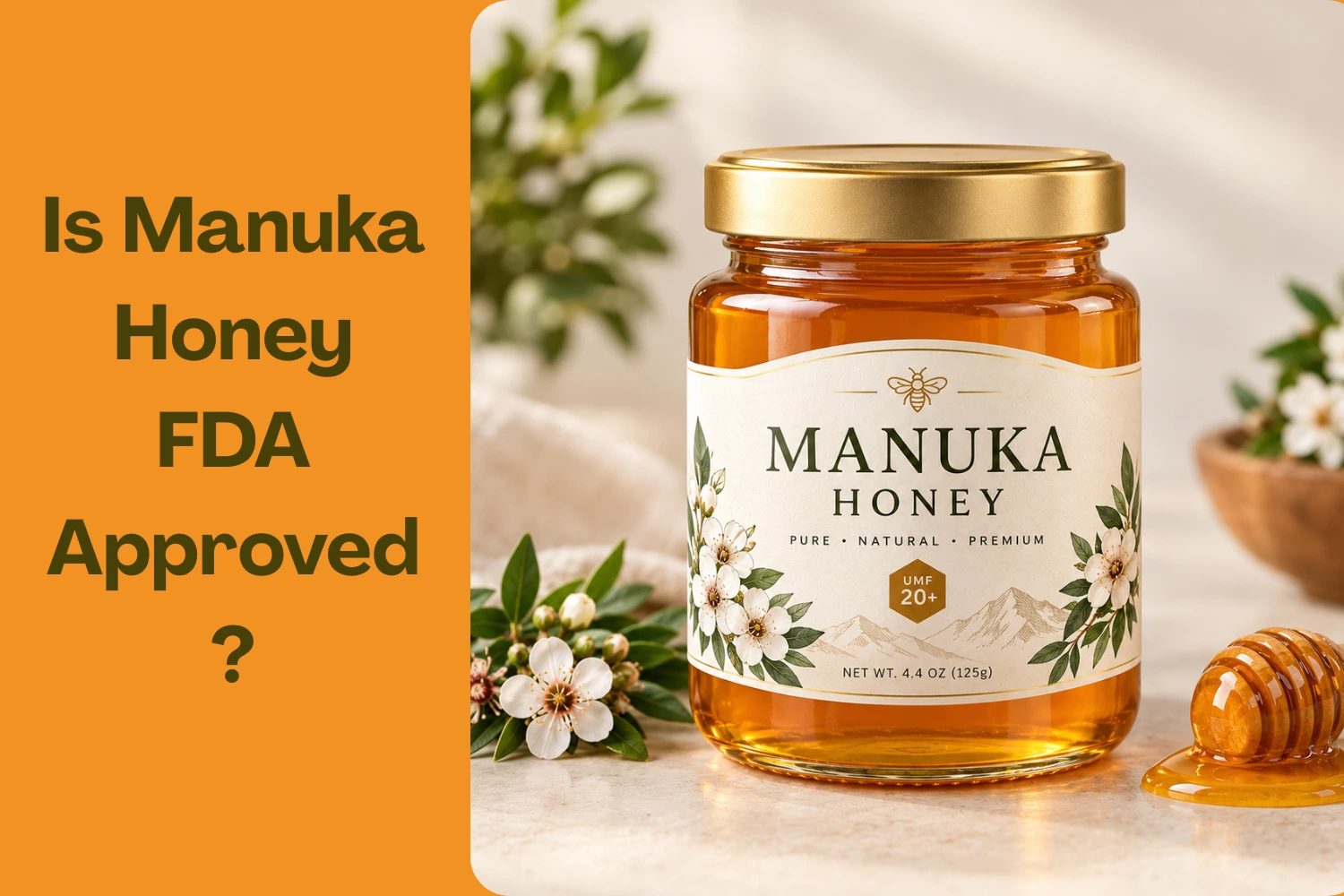
Manuka honey is not, and cannot be, “FDA approved” the way a drug is. Manuka honey is generally sold in the US as a conventional food, and FDA does not generally approve finished food products or individual food labels before they’re marketed, so a jar of honey doesn’t receive an “FDA approved” designation the way a new drug does. That doesn’t mean honey is unregulated. The real question is whether a brand’s specific claim, wherever it appears, is a permitted structure/function claim or an illegal disease claim. This page explains the framework, it isn’t legal advice.
Why “FDA Approved” Isn’t the Right Question
FDA does not generally approve finished food products or individual food labels before they go to market. Some food ingredients, including certain food and color additives, can require FDA premarket authorization, but that’s a different thing from the finished product itself carrying an “FDA approved” status. Food makers remain responsible for complying with labeling, safety, and advertising rules either way. A brand claiming “FDA approved” on a honey label, or implying FDA has endorsed its health benefits, is making a claim that doesn’t apply to its own product category, whether that comes from confusion or deliberate misdirection.
What Brands Can Legally Claim
The rules differ depending on how the product is marketed. The Dietary Supplement Health and Education Act (DSHEA) of 1994 created a special structure/function claim framework, language describing a product’s role in the body’s normal structure or function, specifically for dietary supplements, including the formal disclaimer and a 30-day FDA notification requirement. Most Manuka honey is sold as a conventional food, not a supplement, and conventional-food makers aren’t required to submit that same notification or use that disclaimer, though their claims still have to be truthful, non-misleading, and carefully framed in full marketing context, not just technically avoiding the words “treat” or “cure.”

If a Manuka product is specifically marketed and labeled as a dietary supplement rather than plain honey, the full DSHEA requirements apply: substantiation that the claim is truthful, notification to FDA within 30 days of first marketing it with that claim, and the required disclaimer.
One example worth being direct about rather than treating as a safe default: describing honey as “antibacterial,” “antifungal,” or able to fight pathogens is not a reliably permissible general-wellness claim. FDA has cited this exact kind of language, among other statements, as evidence establishing a honey product’s intended use as a drug in multiple real warning letters, detailed below. Whether a specific statement crosses the line depends on its full context, not the word choice alone.
The Line They Can’t Cross: Disease Claims
A disease claim, one that explicitly or implicitly suggests an effect on a disease, a disease symptom, or an abnormal condition, legally converts that product into an unapproved drug. This isn’t limited to the jar label itself, FDA can and does consider a company’s website, linked articles, testimonials, social media posts, and other marketing material when evaluating what a product is actually being sold to do.
This isn’t hypothetical. FDA issued a real warning letter to Honey Feast, Inc. (March 2022) after reviewing the company’s website, citing statements including that honey’s compounds “give honey its anti-fungal and antibacterial powers,” references to H. pylori and stomach ulcers, claims that honey can be used to treat wounds, and claims about healing burns and reducing heart disease risk, among the evidence establishing the products’ intended use as drugs. Separate warning letters to other honey sellers (Bee Healthy Farms, 2023, and Bee Delightful, 2020) cited similarly worded “antibacterial” and “antifungal” claims, plus statements like “heals wounds,” among their own violations.
Claims that a honey product heals wounds, kills H. pylori, treats infections, or prevents a named disease are high-risk drug claims regardless of how much lab research exists behind the underlying compound. A statement like “soothes an occasional scratchy throat” is less explicit than a direct disease-treatment claim, but its legality still depends on the full context it appears in, including any nearby disease references, imagery, and substantiation, not the wording alone. Educational content should stay clearly separated from product marketing, and shouldn’t present research findings as a reason to buy a specific product for disease treatment, our full evidence-graded look at Manuka honey’s health claims frames every specific topic around what studies found rather than what any product does for you, for exactly this reason.
The Required Disclaimer
This applies specifically to qualifying dietary-supplement structure/function claims, not to honey sold as a conventional food. Where it does apply, the exact, required wording is: “This statement has not been evaluated by the Food and Drug Administration. This product is not intended to diagnose, treat, cure, or prevent any disease.” Both sentences are required, and the regulation also specifies formatting details, like boldface type and placement directly adjacent to the claim it accompanies.
How to Spot a Claim That’s Pushing the Line
A simple test: if a claim says a product “supports,” “maintains,” or “promotes” something general, like wellness, energy, or a normal body function, it’s likely a structure/function claim. If it says the product “treats,” “cures,” “prevents,” or “heals” a specific named condition or disease, that’s a disease claim, and it shouldn’t appear on a food or supplement label at all. Where a UMF or MGO grading claim fits in is worth noting too, those describe tested potency, a separate system from FDA claim regulation entirely, a high grade doesn’t make a disease claim any more legal. What “Manuka” is legally required to prove for export covers a related but separate legal question, product identity and origin, not health-claim law, if you’re trying to untangle the different kinds of regulation that apply to a jar.
FAQ
Does UMF or MGO grading have anything to do with FDA rules?
No. UMF and MGO are grading and measurement systems associated with Manuka honey’s quality and composition, they don’t authorize or clear any FDA health claim. A product can meet a private grading standard and still carry an illegal disease claim, and the absence of a UMF or MGO grade doesn’t itself determine whether a health claim is lawful either. The two systems answer completely different questions.
What happens to a brand that makes an illegal disease claim?
FDA can issue a warning letter or pursue other enforcement measures, and if disease-related claims establish that a food is intended for use as a drug, FDA may treat it as an unapproved new drug and, depending on the circumstances, misbranded. In the real 2022 warning letters to honey sellers cited above, FDA directed the companies to correct the violations and noted that failing to do so could lead to further legal action, including seizure or injunction.
Is this page giving legal advice to brands?
No. This is general public information about how food and supplement claim regulation works, not legal counsel for any specific brand or label. More on how our health content is verified and reviewed explains this site’s approach, and any brand with real compliance questions should talk to an actual attorney, not rely on this page.