
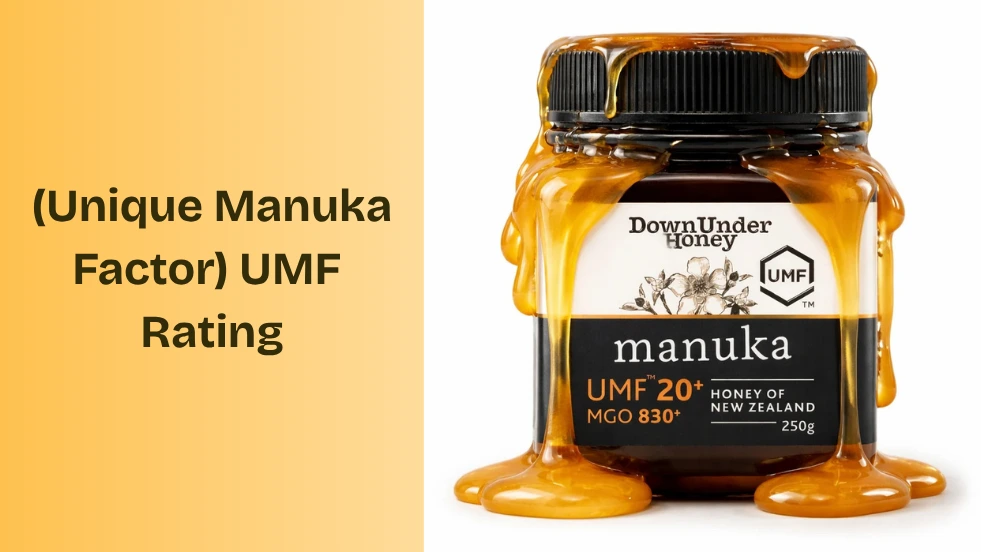
UMF (Unique Manuka Factor) grades Manuka honey using four markers: methylglyoxal, leptosperin, DHA, and HMF. Each tier from 5+ up guarantees a minimum methylglyoxal level, confirmed through a real UMFHA license. For daily use, UMF 10+ is the common floor, higher tiers cost more without most buyers tasting the difference.
What Does UMF Actually Measure?
UMF measures more than just Manuka honey’s strength. Its certification looks at four key lab-tested markers—each serving a different purpose, from potency and authenticity to freshness and maturity.
MGO (Methylglyoxal): The main potency marker that determines the UMF grade. Higher UMF ratings require higher verified MGO levels.
DHA (Dihydroxyacetone): The precursor that converts into MGO as honey matures. MGO levels can continue to rise slightly after the UMF rating is established.

Leptosperin: Confirms that the honey is genuinely Manuka. A minimum level of around 100 mg/kg is required for UMF certification, but it does not increase with each UMF tier like MGO.
HMF (Hydroxymethylfurfural): A freshness and quality indicator rather than a potency marker. High HMF levels can indicate excessive heat exposure or poor storage.
UMF Tiers Explained, 5+ to 24+
UMF 5+, the Entry-Level Floor
MGO 83+. This is the minimum floor for UMF certification at all, genuine Manuka, lab-tested and licensed, just at the lower end of the potency range. Comvita and most major UMF brands sell a 5+ line specifically as an everyday, table-honey option.
Worth it for: daily sweetening, tea, or cooking, where potency isn’t the reason you’re buying Manuka in the first place.
UMF 10+, the Common “Worth It” Threshold
MGO 263+. This is the tier most buyers researching Manuka for its graded potency land on, high enough to feel like a meaningful step up from 5+, without the price jump of the tiers above it. I keep a UMF 10+ jar for my own daily coffee routine specifically because of that balance.
Worth it for: the practical floor if the graded potency is actually why you’re buying Manuka, not just its flavor.

UMF 15+, Mid-Tier Potency
MGO 514+, roughly double UMF 10+’s MGO level. The price jump here is real and noticeable, not incremental.
Worth it for: using honey mostly undiluted, straight off a spoon or in tea, rather than stirred into a large drink where it gets diluted regardless of starting potency.
UMF 20+, High Potency
MGO 829+. A meaningfully rarer harvest requirement than 15+, and priced accordingly. This is where “higher is automatically better” starts to matter less for most everyday use cases.
Worth it for: wanting real margin, either because a jar sits unused for a while, or because you’re using it concentrated rather than diluted.
UMF 24+, a Very High, Rare Tier
MGO in the range of 1,100+ on current listings from some UMFHA-licensed brands. I want to flag something directly here: unlike 5+ through 20+, which are consistently documented across brands, 24+ isn’t a fixed ceiling the whole system tops out at. Some brands market rare batches even higher, into the high 20s or 30s, when a given harvest happens to yield that much.
Worth it for: treat 24+ as “very high and very rare,” not “the top of the scale.”
Which UMF Tier Is Worth the Price Jump?
For daily use, tea, coffee, cooking, general sweetening, UMF 10+ is the practical ceiling worth paying for. Past that, you’re mostly paying for rarity and a bigger buffer, not a difference most people can taste or would notice in diluted, everyday use.
The tiers above 15+ make more sense for targeted, undiluted use or as a gift where the higher number itself is part of the point. If you’re buying for yourself and drinking it in coffee or tea most days, the honest advice is to stop at 10+ or 15+ and put the difference toward buying more often instead of buying higher.
How UMF Compares to MGO, KFactor, and NPA (Quick Reference)
MGO alone states a methylglyoxal number without the authenticity checks UMF requires, some smaller brands use MGO-only labeling to skip UMFHA’s licensing costs. KFactor, used on Wedderspoon’s labels, measures something else entirely: pollen count, not methylglyoxal or leptosperin. A KFactor number doesn’t convert to a UMF or MGO number, they’re not on the same scale at all.

NPA (non-peroxide activity) is an older term for roughly the same underlying property UMF measures, and the two are close to numerically interchangeable on jars that still use it. For the full side-by-side breakdown of how all four systems actually compare, see our full grading systems comparison.
How to Verify a Real UMF License Number
Here’s the exact process I use before trusting any UMF-labeled jar, using a Comvita jar as the walkthrough example:
- Find the UMFHA license number printed on the label. It’s usually near the UMF trademark itself, a specific number tied to that brand, not a generic logo.
- Check it against UMFHA’s own license holder records. A genuine number comes back active and assigned to the brand on the jar. A number that doesn’t match, or doesn’t exist, is a real red flag.
- Don’t confuse this with MPI certification. MPI (New Zealand’s Ministry for Primary Industries) handles export and origin certification at the government level. UMFHA’s license is a separate, private grading certification. A jar can be legitimately MPI-cleared for export without having a real UMF grade behind it.
- Check the HMF reading if it’s available on the batch certificate. A UMFHA license confirms the brand is real. It doesn’t guarantee the specific jar in your hand hasn’t been mishandled since testing, that’s what a clean HMF number rules out separately.
FAQ
What does UMF 5+ mean?
It’s the entry floor for UMF certification, MGO 83+, genuine and lab-tested, just at the lower end of the potency range. It’s a legitimate everyday honey, not a lesser or fake version of higher tiers.
Is UMF the same as KFactor?
No. UMF certifies methylglyoxal alongside leptosperin, DHA, and HMF. KFactor measures pollen count only. The two numbers aren’t measuring the same thing and don’t convert to each other.
How do I verify a UMF license number is real?
Check the license number printed on the jar against UMFHA’s own published license holder records. A genuine jar’s number comes back active and matched to the brand on the label, not blank or assigned to someone else.
What’s the difference between UMF and MPI certification?
MPI is New Zealand’s government body handling export and origin certification. UMFHA is a separate, private industry association that grades potency and authenticity. A jar can carry one without the other, they’re answering different questions.