
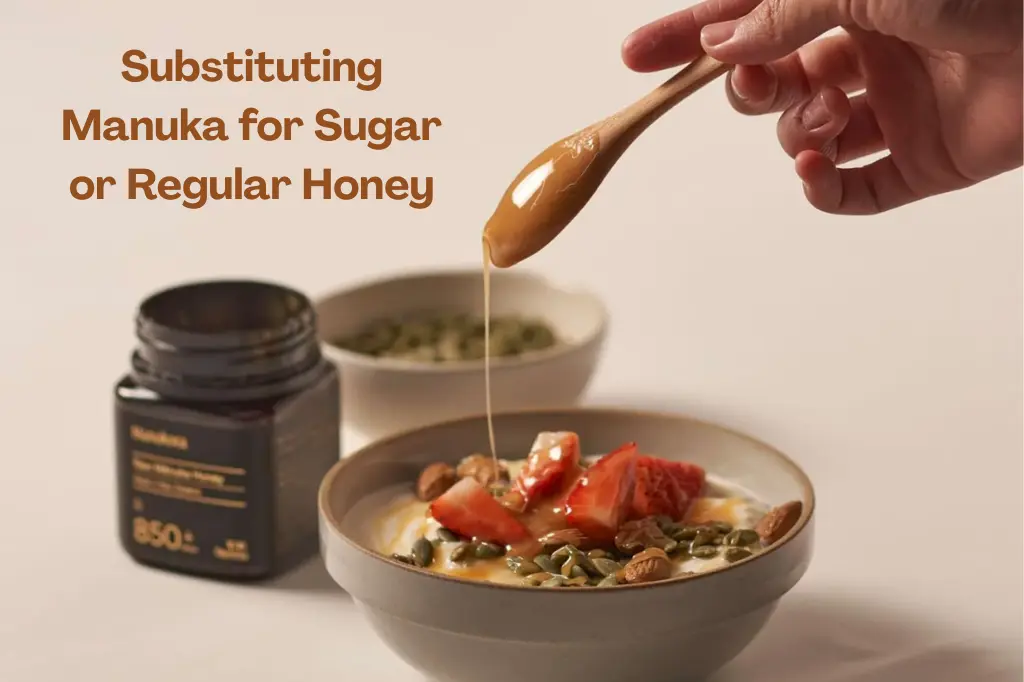
When replacing all the sugar, a common starting point is about three-quarters of a cup of honey per cup of sugar, a quarter cup less liquid per cup of honey, a little baking soda, and a 25°F cooler oven. Manuka swaps one to one for regular honey. For potency, add it off the heat.
Swapping Manuka for Regular Honey
This is the easy one. Swap Manuka for regular honey one to one by volume, and you don’t need to change anything else in the recipe.
The one catch is flavor. Manuka is thicker and usually tastes stronger and earthier than a mild raw honey, so in a delicate bake it can take over. In a recipe with plenty of other flavor, you’re much less likely to notice the difference.
Swapping Manuka for Sugar: The Ratio
Honey tastes sweeter than sugar by volume, so you need less of it. Guides give a range, and the honest answer is that no single number is the truth:
- Common default: about 3/4 cup honey per 1 cup sugar.
- Lower end: some guides suggest starting at 1/2 cup and tasting, for a less sweet result.
- National Honey Board: suggests using honey for up to half the sweetener in a recipe when you’re converting one for the first time.
Those two pieces of advice work together, they don’t compete. The “up to half” tip is a beginner safety rule about how much of the sugar to replace on a first try. The 3/4 cup ratio is what you use for the sugar you do replace. So if you’re replacing half of a 1-cup sugar measure, that’s 1/2 cup of sugar swapped for about 3/8 cup of honey.

The Adjustments That Matter
Honey adds moisture, is mildly acidic, and browns faster than sugar. Three adjustments deal with that, and the National Honey Board’s guidance, which I’m using as the reference here, gives these figures per cup of honey used. If you’re replacing only part of the sugar, scale the adjustments to the amount of honey you actually use:
| Adjustment | Per 1 cup of honey | What the sources say |
|---|---|---|
| Liquid | Reduce other liquid by about 1/4 cup | National Honey Board and most guides agree |
| Baking soda | Add about 1/4 to 1/2 teaspoon | National Honey Board says about 1/2 teaspoon, many other guides say 1/4 teaspoon |
| Oven | Lower by 25°F, check a few minutes early | Broad agreement |
Liquid
Honey is roughly 17 to 20% water, so pull back the other liquid by about 1/4 cup per cup of honey. If the recipe has no other liquid to cut, some guides add a couple of tablespoons of flour per cup of honey instead.
Baking Soda
Honey is mildly acidic, and a little baking soda balances that and helps the bake rise. The range across sources is 1/4 to 1/2 teaspoon per cup of honey, added if the recipe doesn’t already include baking soda. If it already does, guides differ: some say you don’t need more, while others add a pinch or two on top, so this is a judgment call, especially when you’re replacing a lot of the sugar. The adjustment is mainly for quick breads, muffins, and cakes, and it isn’t needed for yeast breads.
Oven Temperature and Timing
Honey’s sugars caramelize at a lower temperature than table sugar, so honey bakes brown faster. Drop the oven by about 25°F and start checking for doneness a few minutes early. If the top is browning before the middle is done, tent it with foil.
A Worked Example
Say a recipe calls for 1 cup of sugar and 1/2 cup of milk, baked at 350°F. Swapping in 3/4 cup of honey means cutting the milk by about 3 tablespoons, since the rule is about 1/4 cup of liquid per cup of honey, and 3/4 cup of honey times 1/4 cup is 3 tablespoons. So use 5 tablespoons of milk instead of 8. Add roughly 1/4 to 3/8 teaspoon of baking soda, depending on which guidance you follow, if the recipe doesn’t already have any, and bake at 325°F.
When to Add It: In the Batter or Off the Heat
This is the decision that protects the expensive jar. Published testing found MGO showed little loss in a 10-minute test up to about 90°C, was significantly reduced above about 100°C, and dropped to roughly 12% of its original level at 150°C for 10 minutes. A related study found some loss under other 90°C conditions too, so time matters as well as temperature. The heat science is covered in full here.
What that means for a recipe:
- If MGO is why you bought Manuka: baking it in works against that goal. Stir it into a glaze, frosting, or dressing after cooking, or drizzle it on once the food is out of the oven and warm rather than scorching hot.
- If flavor is the goal: baking it in is fine. Just expect it to taste a bit different from unheated honey.
- Lowering the oven 25°F doesn’t change the main point. A 325°F oven is still above 100°C. In a moist batter, the honey’s temperature may stay closer to 100°C for a while as water evaporates, which could limit loss compared with dry, high-heat cooking, but prolonged baking can still reduce MGO, and the studies tested honey heated directly, not honey inside a batter. If MGO is your priority, add Manuka after cooking, once the dish has cooled from steaming hot to warm.
Cold uses need no adjustments at all. Manuka Honey Balsamic Dressing is a good example of a recipe where the honey never meets heat.
Where the Swap Works Best
Earthy, spiced, or whole-grain bakes tend to suit a stronger honey better than delicate cakes: gingerbread, oat cookies, bran muffins, and whole-wheat quick breads all have enough flavor of their own to stand next to it. Delicate vanilla cakes and light sponges are where a strong honey is most likely to dominate.
Cold uses, like dressings or a drizzle over a cheese board, skip the math entirely, and there are other everyday ways to use it and how much beyond baking.
Which Grade to Use
A lower-to-mid grade, UMF 5+ to 10+ (roughly MGO 83+ to 263+, an approximate conversion that varies slightly by source), is usually the sensible choice for anything baked in, since heat is likely to reduce MGO anyway. Our full guide to cooking with Manuka covers grade choice in the kitchen.
FAQ
Do I still need to change anything for a small amount?
Less than you’d think. For very small amounts, a tablespoon or two, you can usually skip the baking soda and liquid adjustments, but still watch the browning, since honey colors faster than sugar, and consider a slightly lower oven if the recipe is sensitive.
Why did my swapped bake come out too dark?
Honey browns faster than sugar. Lower the oven by 25°F, start checking a few minutes early, and tent the top with foil if it’s darkening before the middle is done.
Can I use Manuka in a no-bake recipe?
Yes, and it’s the case where you don’t need to adjust anything. With no heat involved, you keep everything the honey offers, and you can swap it for another honey one to one.