
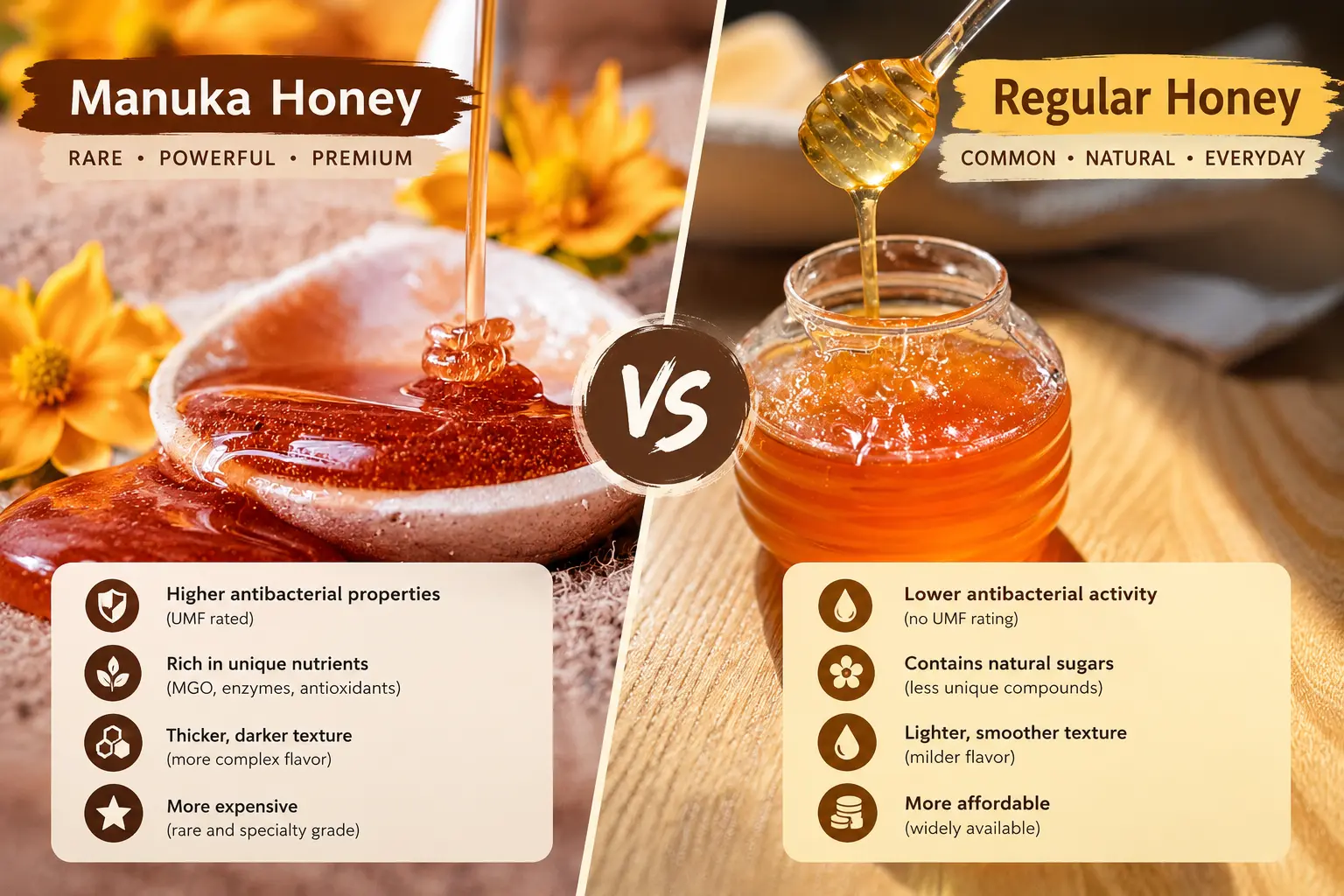
For cooking, baking, and everyday sweetening, good raw honey is the better value, often at a fraction of the cost per teaspoon. Manuka’s premium pays off in cold or finishing uses, where its richer, earthier flavor is the point. The two also aren’t opposites, since a Manuka jar can be raw too.
“Raw” and “Manuka” Aren’t Opposites
This comparison gets muddied because it sets two different kinds of label against each other. “Raw” describes processing: honey that hasn’t been pasteurized or heavily filtered. “Manuka” describes the floral source and how the jar is graded, through MGO or UMF. UMF (Unique Manuka Factor) and MGO (methylglyoxal) are lab-tested markers used to grade Manuka honey.
A jar can be raw, Manuka, both, or neither. Some Manuka brands describe their honey as raw and unpasteurized, and plenty of raw honey has nothing to do with Manuka. So the real question isn’t “raw or Manuka,” it’s what each jar’s price actually buys you in the way you plan to use it.

What You’re Actually Paying For
Here’s the math, using listed prices from the rest of this site’s research, one organic raw honey and one Manuka jar:
| Y.S. Eco Bee Farms Organic Raw (32oz) | Comvita UMF 10+ (250g / 8.8oz) | |
|---|---|---|
| Listed price | about $22 | $34.99 |
| Weight | about 907g | 250g |
| Price per ounce | about $0.69 | about $3.98 |
| Price per gram | about $0.024 | about $0.140 |
| Price per teaspoon (7g) | about $0.17 | about $0.98 |
The formula is jar price divided by grams, then multiplied by 7 for a rough teaspoon, so you can rerun it with whatever two jars you’re actually comparing. On these numbers, Manuka works out to several times more per teaspoon, and the exact gap depends on the brand, grade, and jar size you compare.
Higher Manuka grades push that gap wider. Our full guide to buying good everyday raw honey covers the raw side of this comparison in more depth.
Flavor and Texture: Does Manuka Taste Better?
Sources describe Manuka as richer, earthier, and thicker than most everyday honey, sometimes with a slightly medicinal or bittersweet edge, especially at higher grades. A typical good raw honey is usually described as milder, floral, and more familiar. That’s what reviews and brand descriptions report, not yet a blind test from this site.
Manuka’s taste also varies by region, season, and grade, ranging from woody and earthy to caramel or toffee, with some batches noticeably more medicinal than others. If yours tastes more caramel than earthy, that’s within the normal range, not a sign something’s off.
Whether that makes Manuka “better” is really a question of whether you prefer different. If you like that earthy, savory edge, it’s a distinct flavor other honeys don’t quite match. If you want plain sweetness with a floral note, a good raw honey may taste better to you, and that’s a legitimate preference, not a knock on either jar.
Where Raw Honey Wins
Raw honey wins anywhere the honey is going to be diluted, heated, or mostly there for sweetness:
- Baking and glazes: once honey is mixed into a batter or cooked into a glaze, much of what makes Manuka distinct gets muted, and sustained high heat, especially above about 100°C, can reduce MGO, the compound its grades are built around, along with more heat-sensitive enzymes and aroma compounds. Gentle warming is a different thing from sustained high-heat cooking. The heat science is its own topic, and our full guide to cooking with Manuka covers the practical side.
- Hot tea and drinks by the mug: a daily-volume use where a jar disappears quickly, and the price per teaspoon adds up.
- Everyday sweetening: toast, oatmeal, and anything where you’re using several spoonfuls at a time.
You can generally swap honey for honey roughly one to one in a recipe, so switching from Manuka to raw honey doesn’t require rewriting anything, though the flavor will be milder. Going the other way, in delicate bakes or light sauces a high-grade Manuka can dominate the flavor and may darken the color more than a mild raw honey would.
Where Manuka Earns Its Price
Manuka earns its cost when the honey is the thing you’re tasting, not an ingredient hidden inside something else:
- Drizzled over cheese: its earthy edge holds up against a sharp cheddar, a blue, or a creamy goat cheese in a way a mild honey can disappear against.
- Over yogurt or fruit: cold, so nothing dilutes or mutes it.
- Spooned straight: where you actually taste the honey on its own.
- Stirred into a drink that has cooled a few minutes: a gentler use than cooking, and the flavor comes through better once the drink isn’t scalding.
A Simple Buying Rule
A good raw honey for anything that goes near heat or gets used by the spoonful all week. A lower-to-mid Manuka grade, roughly UMF 5+ to 10+ (or about MGO 83+ to 263+ on jars labeled that way, an approximate conversion, not an exact equivalence), only for the cold and finishing uses above. That way the expensive jar only ever gets used where its flavor is the point, and the everyday jar does the everyday work.
What About Health Claims?
This page compares kitchen value only. Evidence on health claims lives in the site’s health hub, not here.
FAQ
Can I use Manuka honey as a one-to-one swap for regular honey?
Yes, in most recipes you can swap it roughly one to one. The main difference is flavor, Manuka’s stronger, earthier taste may come through more than you’d expect, and for cooked recipes you’re paying extra for a flavor that gets muted anyway.
Is a more expensive raw honey a better comparison than supermarket honey?
It’s the fairer comparison. Setting Manuka against the cheapest honey on the shelf makes the price gap look bigger than it needs to. A quality organic raw honey, like the one in the table above, is what most people would actually buy instead of Manuka, and even that is still meaningfully cheaper per teaspoon.
Which grade should I buy if I only want one jar?
If you’ll cook, bake, or sweeten drinks daily, one jar of good raw honey is the more practical single purchase. If you specifically want Manuka for cold and finishing uses, UMF 10+ is a sensible everyday grade, it has a recognizably Manuka flavor without the price of the premium tiers. If you want both everyday sweetness and occasional finishing flair, a two-jar approach works well: one larger raw honey for cooking and daily use, and one mid-grade Manuka for drizzling.