
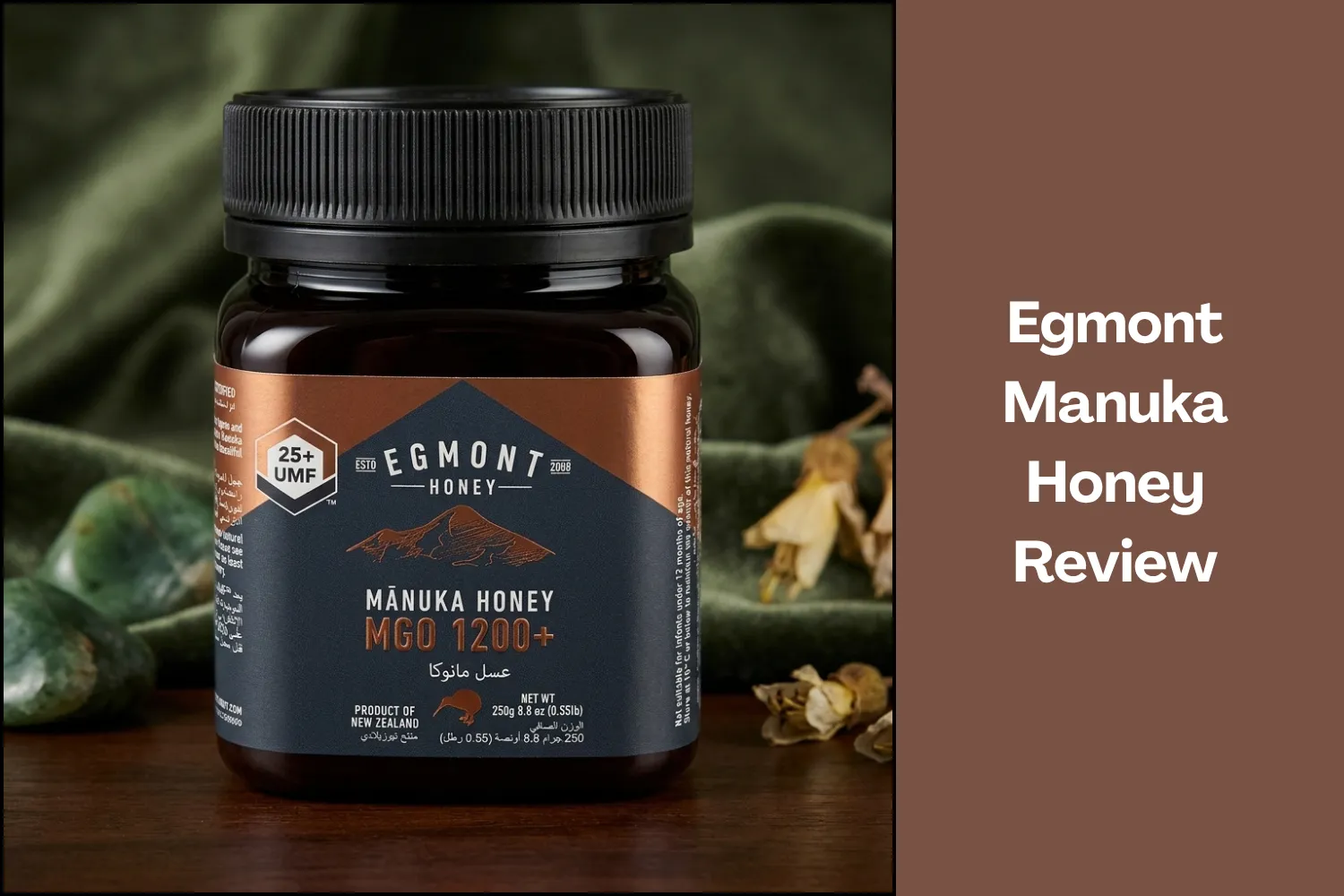
You spot a jar of Egmont next to Comvita, same UMF 10+ grade, a few dollars cheaper, and you’ve never heard of the brand. Fair question: is cheaper and smaller also less reliable?
No. Egmont holds its own UMFHA license (#1888), prints a certified MGO minimum on every US jar, and its UMF 10+ costs about 9 to 10 cents a gram against about 12 cents for Comvita’s UMF 10+.
The one thing I’d watch is storage, because Egmont asks you to keep it cooler than most kitchens run in summer.
| My Egmont verdict at a glance | |
|---|---|
| Grades covered | UMF 10+ (MGO 265+) and UMF 18+ (MGO 700+) |
| UMFHA license | Yes, #1888, Egmont Honey Ltd |
| Label vs certificate | MGO tested by an IANZ-approved lab; match yours by batch number |
| HMF (heat and age marker) | Look for well under 40 mg/kg (the Codex limit) |
| Price per gram, UMF 10+ | $0.09 to $0.10 (Vitacost, Walmart) |
| Best for | Budget UMF 10+ buyers who want a licensed brand |
| Skip if | You can’t keep a jar below 64°F (18°C) |
If you want the full brand lineup first, here’s where Egmont lands among four brands in my ranking. This page sticks to Egmont and goes deep.
My Verdict on Egmont
Egmont is a reliable UMF brand at a lower price, not a cheap knockoff. The thing that settled it for me was the UMFHA register: Egmont Honey Ltd is listed under its own license number, the same system Comvita sits in, so the UMF mark on an Egmont jar means exactly what it means on a Comvita jar. The label backs that up with a certified MGO minimum tested by an IANZ-approved lab.
Where Egmont asks more of you is handling. Its US labels say to store the honey at 64°F (18°C) or below, which is stricter than most brands and cooler than plenty of pantries. So my verdict: buy it for the price if you can keep it cool, and check the batch on arrival like you would with any jar.
What I liked
- Licensing: its own UMFHA license, #1888, on the public register.
- Price: UMF 10+ for about $23 to $24 a 250 g jar, versus about $30 for Comvita’s.
- Labeling: both the UMF grade and a certified MGO minimum printed on US jars.
What I didn’t
- Retail reach: you’ll mostly find it at Walmart, Vitacost and iHerb, not on every grocery shelf.
- Grade naming: in-between steps like UMF 7+, 16+, 18+ and 23+ make shelf comparisons harder.
- Storage advice: the 64°F line is stricter than most buyers follow, especially in summer.
Who Egmont Honey Is
Egmont Honey is a family-owned beekeeping company in Taranaki, on the west coast of New Zealand’s North Island, started in 2008 with a single hive. Toby Annabell got that hive as a gift from his son James, and the business has since grown to about 4,000 hives on the family’s South Taranaki farm, with honey packed at its own factory in New Plymouth. James runs it as CEO and Toby as operations director.
The name comes from Mount Egmont, the older English name for Taranaki Maunga, and the mountain is the one on the label. That’s all you need on the backstory. What matters for buying is that Egmont runs its own hives and its own packing line, and my read is that this helps it price lower than brands with bigger marketing budgets.
Which Egmont Jars This Review Covers
This review focuses on Egmont’s UMF 10+ (MGO 265+) and UMF 18+ (MGO 700+), both in 250 g jars. UMF 10+ is the like-for-like grade against Comvita’s best-selling UMF 10+, and UMF 18+ is the higher grade Egmont sells most widely in the US. I don’t take gifted samples or discount codes from brands, and you can read more about how I buy and test honey on my about page.
When you buy either jar, check the best-by date as well as the batch number. How long a jar has sat around shows up in its HMF number, which matters more than usual for a brand that asks you to store it cool.
Is Egmont’s UMF Certification the Real Thing?
Yes. Egmont is a licensed member of the UMF Honey Association, and the UMF mark on its jars is backed by the same independent testing every other licensee goes through. I ran it through my verification checklist, step by step, the same one I use on every brand.
Looking Up Egmont’s UMFHA License
The UMFHA’s certified brands register lists Egmont Honey Ltd under license #1888. The same license also covers Egmont’s Waimete Honey Co range, so don’t be thrown if you see that name. Only licensed producers can print the UMF trademark, and the register is public, so you can search the brand name and match the number yourself.
Label vs Batch Certificate: What to Look For
A good result is a certificate MGO at or above the label minimum, from a named lab, with a recent test date. Egmont’s US labels say the MGO is tested by an IANZ-approved lab (IANZ is New Zealand’s accreditation body), so the lab should be named on the certificate. Here’s what a passing certificate looks like for the two grades in this review:
| Grade on label | Certificate MGO should be | Also check |
|---|---|---|
| UMF 10+ / MGO 265+ | 265 mg/kg or higher | Lab name, test date, batch number matches jar |
| UMF 18+ / MGO 700+ | 700 mg/kg or higher | Lab name, test date, batch number matches jar |
Leptosperin, DHA, and HMF on the Certificate
Honey’s Leptosperin, DHA, and HMF on the Certificate –
Leptosperin confirms the honey actually came from Manuka flowers. MGO only tells you strength, so this is the number that answers “is it real Manuka?”
DHA is the compound that slowly turns into MGO over time. A healthy DHA reading means the jar still has room to build potency on the shelf.
HMF rises with heat and age, so it tells you how the honey was treated after it left the hive. It gets its own section below, because it’s the best way to judge a smaller brand’s storage.
How Egmont Labels Its Grades (and Why the Numbers Look Odd)
Egmont prints both a UMF grade and an MGO minimum, but its steps don’t follow the usual 5, 10, 15, 20 ladder. US listings show UMF 7+ (MGO 150+), 10+ (MGO 265+), 16+ (MGO 575+), 18+ (MGO 700+), 20+ (MGO 830+) and 23+ (MGO 1,050+), plus MGO-only multifloral jars at 50+ and 100+. A New Zealand distributor says the full range runs from UMF 5+ to UMF 27+ (MGO 1,365+). So if you’re used to comparing a UMF 15+ against another UMF 15+, Egmont often won’t have one to line up.
The MGO numbers also drift between listings. Egmont’s US UMF 10+ jar says MGO 265+, while other markets’ listings for the same grade say 263+, and Vitacost lists the UMF 16+ as MGO 575+ on the 250 g jar and 573+ on the 500 g jar. None of that is a red flag on its own, but it’s exactly why I trust the printed jar and the certificate, not the product listing. If the way the two scales relate is fuzzy, here’s how the UMF and MGO scales line up.
Storage and Heat: Does a Smaller Brand Keep It Cool?
The way to tell is the HMF number on your certificate, and anything well under 40 mg/kg means the jar hasn’t been cooked on its way to you.
Egmont’s 18°C Storage Advice vs How It Ships
Egmont’s US labels say to store the honey at 64°F (18°C) or below, which is cooler than most pantries in summer. That’s stricter than the advice on a New Zealand distributor’s listing for the same UMF 10+, which says room temperature below 25°C (77°F), out of direct sunlight. My take: treat 64°F as the ideal and 77°F as the ceiling, keep it away from the stove and the sunny window, and don’t leave a delivery sitting on a hot porch.
Retail matters here too. Vitacost says it sources from brands or authorized distributors and stores and ships products in conditions meant to protect quality, which is the kind of promise worth looking for with a temperature-sensitive jar.
What the HMF Number Tells You
Look for an HMF well under 40 mg/kg on your certificate. The international Codex honey standard caps HMF at 40 mg/kg after processing, and freshly extracted honey usually sits below 10 mg/kg. HMF climbs faster once honey spends time above about 20°C, so a low number is the clearest sign a jar was stored well.
Egmont at the Same Grade as Comvita
At UMF 10+, Egmont and Comvita carry the same UMFHA mark, so the license means the same thing on both jars. The real question is whether Egmont’s tested numbers and handling hold up, and whether the lower price comes with any catch. Comvita sits in this table only as a fixed reference (its label minimum and shelf price), not as a jar I’m judging here.
| Measure | Egmont UMF 10+ | Comvita UMF 10+ (reference) |
|---|---|---|
| UMF trademark on label | Yes, license #1888 | Yes |
| MGO on label | 265+ mg/kg | 263+ mg/kg |
| Price, 250 g jar | $23.07 (Vitacost), $23.97 (Walmart) | $29.99 (Walmart) |
| Price per gram | $0.09 to $0.10 | $0.12 |
Prices are from October 4, 2026. On paper, Egmont gives you the same certification system and a slightly higher printed MGO minimum for roughly 20 to 23 percent less money. What the paper can’t tell you is how a given jar was stored, which is why the certificate and the HMF number above carry so much weight for a smaller brand. So for the cheaper jar, the batch check isn’t optional. It’s the step that turns a good price into a safe buy.
How Egmont Tastes
Egmont describes its UMF 10+ as rich, treacly caramel, and it’s sold creamed, so it’s thick and spoonable rather than runny. Egmont’s US labels also tag the higher grades, the 18+ included, as “intense,” which in Manuka usually means a darker color and a more bitter, herbal edge. In general it sits in the same caramel-and-earthy family as the bigger New Zealand brands rather than tasting like something different.
UMF 10+ vs 18+: What Changes
Expect the 18+ to taste stronger and more herbal than the 10+. Egmont describes the 10+ as rich, treacly caramel and tags the 18+ as “intense,” and in Manuka a higher MGO usually means a darker color and a more bitter finish. Both are sold creamed, so the texture stays thick either way. If you’re buying for everyday sweetness, the 10+ is the easier spoon.
Does It Hold Up in Coffee?
Egmont pitches the UMF 10+ as a sweetener for hot drinks, and at about 9 cents a gram it’s the grade I’d actually spend on coffee. Let the coffee cool a minute before you stir it in, since very hot liquid thins the creamed texture right away. A latte is the easier place to start, because the milk rounds off that earthy edge.
Is Egmont Worth It? My Price-per-Gram Math
Egmont’s UMF 10+ costs 9 to 10 cents a gram, and the UMF 18+ costs 21 to 24 cents. I divided each shelf price by the 250 g net weight. Prices were checked October 4, 2026, and they move, so treat them as a snapshot.
| Grade | Jar (g) | Price | Price per gram | Retailer |
|---|---|---|---|---|
| Egmont UMF 10+ / MGO 265+ | 250 | $23.07 | $0.092 | Vitacost |
| Egmont UMF 10+ / MGO 265+ | 250 | $23.97 | $0.096 | Walmart |
| Egmont UMF 18+ / MGO 700+ | 250 | $53.64 | $0.215 | Walmart |
| Egmont UMF 18+ / MGO 700+ | 250 | $58.76 | $0.235 | Vitacost |
| Comvita UMF 10+ / MGO 263+ (reference) | 250 | $29.99 | $0.120 | Walmart |
Why is Egmont cheaper? Egmont doesn’t say, so this is my read: it runs its own hives and packing line, has a much smaller retail footprint, and doesn’t spend like a household name on advertising. None of that touches the certification, which is the same system either way. I keep a full price guide by grade elsewhere on the site if you want benchmarks across brands.
My verdict on value: the UMF 10+ is the strongest case for Egmont. You get a licensed UMF 10+ for about a fifth less than Comvita’s. At UMF 18+, the savings are real but the jar is a bigger spend, so the storage question matters more.
Packaging, Serving Size, and Where to Buy
These are the practical details that decide whether a cheaper jar stays a good deal once it’s home.
The Jar, Lid, and Seal
Egmont’s US jars are labeled BPA-free, along with Non-GMO Project Verified, Halal and Kosher Kiwi. The 250 g jar is small and squat (about 6 by 6 by 8.4 cm per iHerb’s listing), which makes it easy to keep in a cool cupboard rather than on the counter.
How Long a Jar Lasts
At the label’s serving of 1 tablespoon (21 g), a 250 g jar holds about 11 servings. That’s the label’s serving size for nutrition facts, not a recommendation for how much to eat. If you stir a teaspoon (about 7 g) into coffee each morning instead, the same jar lasts roughly five weeks.
Walmart, iHerb, Vitacost, or Amazon?
These are the four places most US buyers look, and they don’t all promise the same sourcing.
- Vitacost: says it sources only from brands or authorized distributors, with no third-party resellers. It also had the lowest UMF 10+ price I found.
- iHerb: lists the full US range, with best-by dates and first-available dates on each product page, so you can see how fresh the stock is.
- Walmart: had the lowest UMF 18+ price, but some listings come from marketplace sellers, so check who’s shipping it.
- Amazon: check that the seller is Egmont or an authorized distributor before you buy.
Wherever you buy, match the batch number on the jar to its certificate when it arrives. A price far below the usual range for the grade, or a jar with no batch number at all, is your cue to send it back.
Who Should Buy Egmont (and Who Shouldn’t)
Egmont makes the most sense for buyers who want a licensed UMF jar at a lower price and can store it properly.
Good fit if you:
- Want a budget UMF 10+: it’s about 9 cents a gram, against about 12 cents for Comvita’s UMF 10+.
- Take a daily spoonful: the UMF 10+ keeps a daily habit affordable.
- Sweeten coffee with it: the coffee covers a lot of the difference between grades, so the 10+ is plenty.
- Have a cool cupboard: you can meet the 64°F (18°C) storage line most of the year.
Skip it if you:
- Want a name you can find anywhere: Egmont’s US retail footprint is thinner than Comvita’s.
- Shop by the 5, 10, 15, 20 ladder: Egmont’s in-between grades make side-by-side shopping harder.
- Live somewhere hot with no cool storage: the jar’s advice is stricter than your kitchen.
Where Egmont Sits Next to Manukora and Wedderspoon
Egmont is the value end of the certified New Zealand brands, not a ranking winner or loser. Manukora sits at the other end on price: its MGO 850+ lists at $80 for 250 g, while Egmont’s UMF 20+ (MGO 830+) was $53.49 at Walmart, and I’ve done the Comvita and Manukora price-per-MGO math separately if you want to see that spread in detail. Wedderspoon labels with KFactor, which counts pollen rather than methylglyoxal or leptosperin, so its numbers can’t be lined up against Egmont’s UMF at all. For scores and an overall order, see the ranking linked near the top of this review.
Egmont Honey FAQ
Is Egmont honey real Manuka?
Yes. Egmont’s Manuka grades are UMF certified, and UMF testing includes leptosperin, the marker that confirms Manuka origin. Egmont also makes cheaper multifloral Manuka jars labeled only with MGO (50+ and 100+), so check which kind you’re buying.
Is Egmont UMF licensed?
Yes. The UMFHA’s public register lists Egmont Honey Ltd under license #1888. You can search the register by brand name and match the number yourself.
Is Egmont as good as Comvita?
At UMF 10+, Egmont carries the same certification as Comvita for about a fifth less money. The same-grade section above shows the full comparison.
How should I store Egmont Manuka honey?
Egmont’s US labels say to store it at 64°F (18°C) or below. Keep the lid tight, keep it away from the stove and sunny windows, and treat about 77°F (25°C) as the upper limit. Heat raises HMF and slowly wears down the honey’s quality.
Is Egmont honey raw?
Egmont’s US jars are labeled raw and unpasteurized. It’s also sold creamed, which gives it a thick, spoonable texture without heat treatment.