
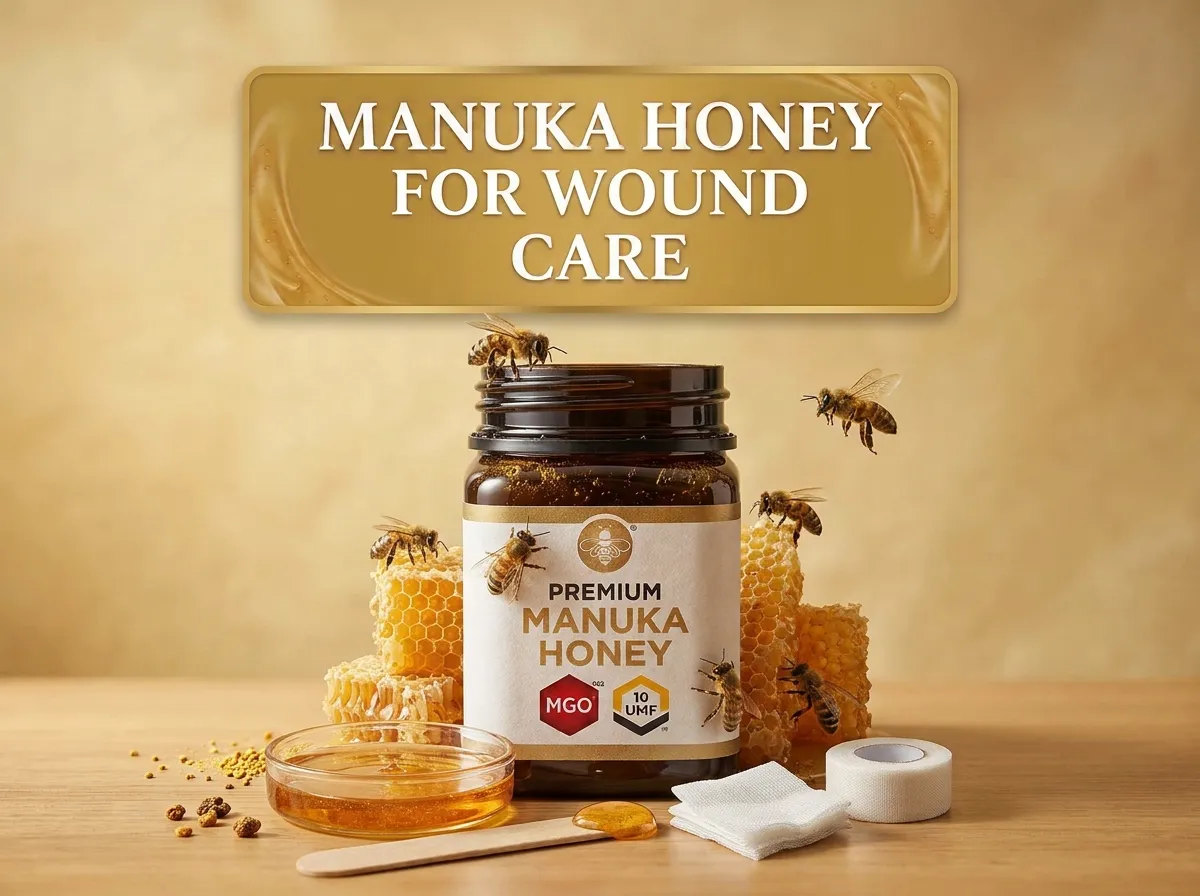
Medical-grade Manuka honey has real clinical evidence behind it for certain wound types, evidence that’s genuinely stronger than for many other Manuka health claims. That evidence comes from sterile, regulated wound-care products, not the honey sold in a grocery store or even a premium retail jar, and it’s strongest for burns and infected post-operative wounds specifically, not chronic wounds generally. This page describes what the research shows, not a method for home use.
At a glance:
- Strongest evidence: partial-thickness burns, infected post-operative wounds
- Chronic wounds (diabetic foot ulcers, pressure ulcers, venous leg ulcers): low to very low certainty
- Medical-grade, sterile dressings are not the same as retail honey jars
- MGO is the compound researchers point to, but there’s no single “required” MGO number across every product studied
What the Evidence Shows, By Wound Type
The evidence for topical honey treatment varies significantly depending on the specific type of wound being treated. The most cited reference on this topic is the 2015 Cochrane systematic review, “Honey as a Topical Treatment for Wounds” (Jull, Cullum, Dumville, Westby, Deshpande, and Walker), which evaluated roughly 26 randomized or quasi-randomized trials covering burns, lacerations, surgical wounds, and chronic wounds.
Key Evidence Points
- Partial-Thickness Burns: Honey healed partial-thickness burns faster than conventional treatments (such as polyurethane film, paraffin gauze, and sterile linen).
- Infected Post-Operative Wounds: Honey healed infected surgical wounds more quickly than standard antiseptics or gauze.
- Venous Leg Ulcers: A related randomized trial using honey-impregnated dressings showed a 55.6% healing rate at 12 weeks versus 49.7% with usual care—a difference determined not to be statistically significant.
- Chronic Wounds (Diabetic Foot Ulcers, Pressure Ulcers, Venous Leg Ulcers):
- Evidence certainty is generally low to very low.
- Major guidelines highlight that underlying trials are heterogeneous and carry a meaningful risk of bias.
- While some newer reviews cite “Level 1a” evidence for certain Manuka dressings (indicating inclusion in systematic reviews), this does not mean high-quality reviews have proven efficacy across all chronic wound types.
While high-certainty evidence supports the use of medical-grade honey for partial-thickness burns and infected post-operative wounds, the evidence for chronic wounds remains mixed, low-certainty, and insufficient to support a blanket claim of efficacy across all wound types.
What Grade the Research Actually Uses
Medical-grade honey products used in research and clinical settings are specially formulated, sterile medical devices (such as sterile sheet dressings) available over-the-counter or by prescription. They are distinct from standard retail jars of honey sold with a grade printed on the label.
Key Grading Points
- Common Potency Levels: Clinical education and product registration materials frequently note MGO 400+ as a minimum baseline, with many studied dressings utilizing high-grade Manuka, such as UMF 20+ (roughly MGO 829+) or higher.
- Lack of Universal Standard: There is no single, universally mandated MGO threshold across all clinical trials.
- Regulation vs. Rating: Products are regulated primarily as sterile medical devices based on sterility and standardized dosing, rather than retail potency labels.
- System Disconnect: Products graded by UMF or MGO are not strictly interchangeable with regulated medical devices classified by sterile preparation standards.
A potency grade on a retail jar does not automatically translate to clinical efficacy. Conflating retail honey ratings (like MGO or UMF) with sterile, regulated medical-grade wound care devices overstates what a single potency number can guarantee.
Retail Jar vs Medical-Grade Dressing (Why They’re Not the Same Thing)
This is the distinction that matters most here. The honey studied in most clinical wound trials is a sterile, medical-grade formulation, manufactured, tested, and regulated specifically as a wound-care product. These products are typically gamma-sterilized under standardized conditions to reduce microbial load while aiming to preserve the honey’s bioactivity, a process retail honey doesn’t undergo. A jar of Manuka honey from a grocery store or even a premium retailer, however genuine and well-graded for UMF or MGO, has not gone through that same sterilization and regulatory process.
“Honey with antibacterial properties” and “a regulated wound-care product” are different things, even when the underlying compound, methylglyoxal, is the same one researchers point to in both.
Why It Might Work: The Proposed Mechanism
Researchers credit methylglyoxal with much of the antibacterial and antibiofilm activity measured in these studies. Other compounds present in Manuka honey, including various phenolics and a compound sometimes referred to as leptosin, are noted in the research as possibly contributing to the effect as well, though exactly how these components interact isn’t fully mapped, an open question the cited literature itself acknowledges rather than something settled.
This is described here as a proposed mechanism because that’s how the research itself frames it, not as an established, complete explanation.
FAQ
Are there risks to using honey on a wound?
Yes, and this is a real reason self-treatment isn’t advisable. Non-sterile honey can carry contaminants that a medical-grade, sterilized product doesn’t, and using the wrong product on a wound that needs different care can delay proper treatment. Reported adverse events in trials of medical-grade products include pain or stinging on application and occasional allergic reactions, medical-grade formulations are designed to minimize contamination risk, but any topical agent can still cause irritation in some people. This is a question for a clinician evaluating your specific wound, not something this page can answer for you.
Is this the same evidence used for sore throats or gut health?
No. Wound-care evidence, general consumption, and other specific health topics are each their own separate body of research with different products, different evidence strength, and different questions being asked, they shouldn’t be assumed to transfer from one to another. General guidance on how Manuka honey is typically consumed covers everyday use specifically, a different topic from the clinical wound-care evidence described here.
Where can I read the actual studies?
The Cochrane review cited above, “Honey as a Topical Treatment for Wounds” (2015, CD005083), is publicly searchable through the Cochrane Library. Our full evidence-graded look at Manuka honey’s health claims covers other specific claims with the same sourcing standard, and more on how our health content is verified and reviewed explains this site’s approach to evidence-based coverage generally.