
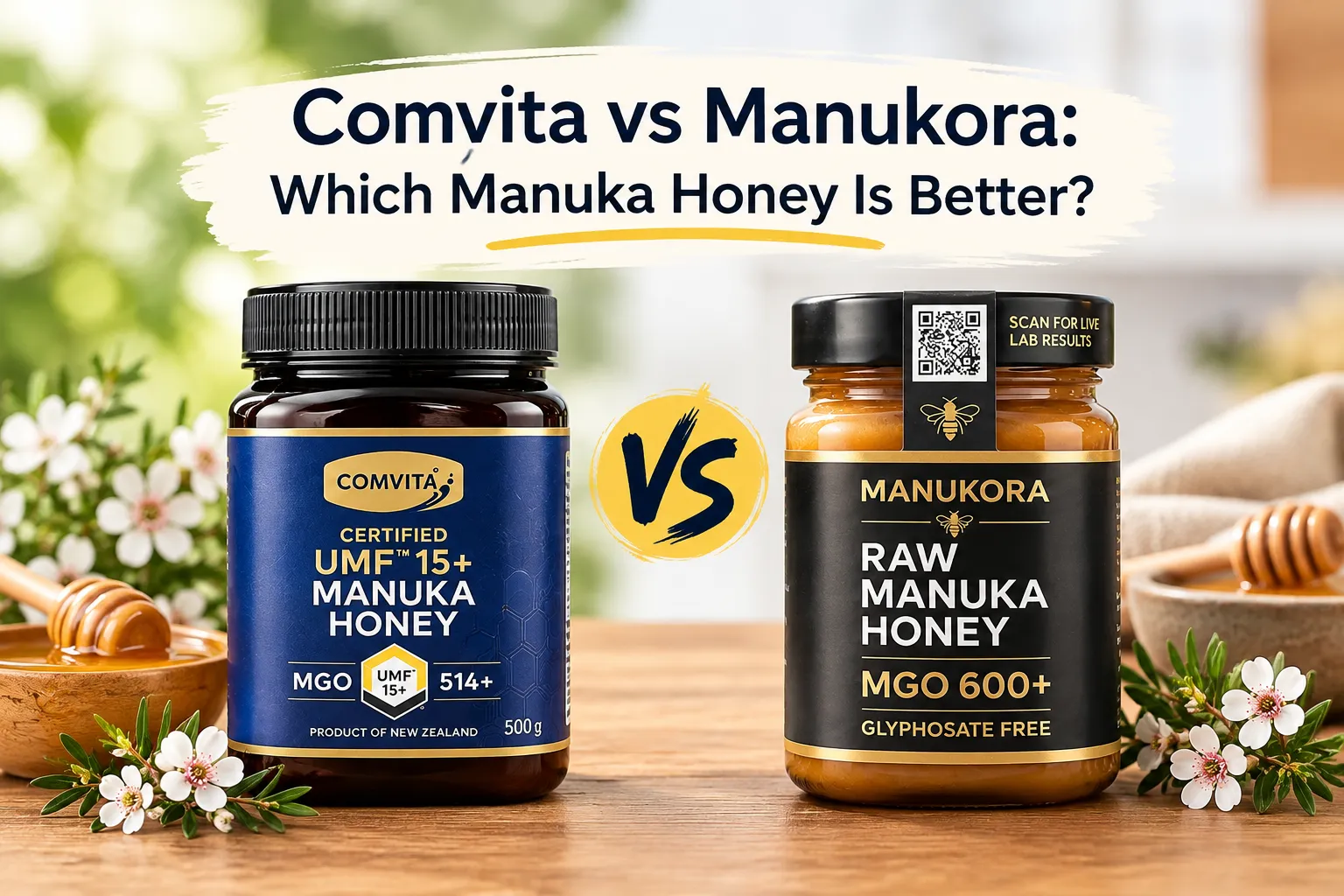
Manukora gives more certified MGO per dollar at both grades I compared: 2.7 to 2.9 mg per dollar for its MGO 600+ versus 2.6 for Comvita UMF 15+, and 2.7 versus 1.7 at UMF 20+, using October 2026 prices. Comvita still makes sense if you shop store shelves and catch a sale.
Comparing these two by eye is harder than it should be. Comvita puts UMF on the front of the jar, Manukora leads with MGO, and one brand sells mostly on store shelves while the other pushes a subscription. So I turned everything into one number you can compare: milligrams of certified MGO per dollar.
A quick note on how I got there. This comparison uses each jar’s certified minimum MGO and current retail prices, not batch certificates from jars I bought, because I haven’t run my own side-by-side test of these two yet. When I do, I’ll add the certificate numbers here. If you haven’t narrowed it to these two yet, see all four big brands ranked together.
My Pick at Each Grade
Manukora wins both grades on MGO per dollar, but only the higher grade is a clear win. At the UMF 15+ to 16+ level the gap is small enough that a Comvita sale flips it.
| Mid grade (UMF 15+ to 16+) | |
|---|---|
| Top pick | Manukora MGO 600+ (UMF 16+) |
| MGO per dollar | 2.7 to 2.9 mg, versus 2.6 for Comvita UMF 15+ |
| Why it wins | More MGO in the jar (600 vs 514 mg/kg minimum) for only a few dollars more |
| Buying | Walmart and manukora.com, $52 to $55 for 250 g |
| Honest con | Comvita UMF 15+ wins if it drops below about $47 |
| High grade (UMF 20+) | |
|---|---|
| Top pick | Manukora MGO 850+ (UMF 20+) |
| MGO per dollar | 2.7 mg one-time, 3.3 mg on subscription, versus 1.7 for Comvita UMF 20+ |
| Why it wins | Slightly higher minimum (850 vs 829 mg/kg) at about two-thirds of Comvita’s price |
| Buying | manukora.com, $80 one-time or $64 on subscription |
| Honest con | You mostly buy it online, and the best price means committing to a subscription |
So if you’re buying the high-strength jar, Manukora is the easy call. At the mid grade, I’d buy whichever one is cheaper the day you shop.
How Comvita and Manukora Grades Line Up
The two brands don’t sell identical grades, so I matched them on UMF level. Comvita sells UMF 5+, 10+, 15+, 18+ and 20+, and Manukora sells MGO 600+, 850+ and 1000+ direct. Only two pairs land close together:
| Pair | Comvita | Manukora | Certified MGO minimum (mg/kg) |
|---|---|---|---|
| Mid grade | UMF 15+ | MGO 600+ (UMF 16+) | 514 vs 600 |
| High grade | UMF 20+ | MGO 850+ (UMF 20+) | 829 vs 850 |
Comvita leads with UMF and Manukora with MGO, but both numbers point at the same thing: a certified minimum of methylglyoxal. That’s why the mid pair still works even though Manukora’s jar is a notch stronger. MGO per dollar adjusts for the difference, so you’re comparing like with like.
One brand that can’t join this math is Wedderspoon. It grades with KFactor, which counts pollen rather than MGO or leptosperin, so there’s no MGO figure to divide by the price.
The Four Jars Compared
All four jars are 250 g, so the price per gram lines up directly. These are the US prices I found on October 4 and 5, 2026, at the retailers where each jar was easiest to buy.
| Brand | Grade | Jar size (g) | Retailer | Price (USD) | Price per gram |
|---|---|---|---|---|---|
| Comvita | UMF 15+ (MGO 514+) | 250 | Vitacost (sale) | $49.99 | $0.20 |
| Manukora | MGO 600+ (UMF 16+) | 250 | Walmart | $52 to $55 | $0.21 to $0.22 |
| Comvita | UMF 20+ (MGO 829+) | 250 | Vitacost | $119.84 | $0.48 |
| Manukora | MGO 850+ (UMF 20+) | 250 | manukora.com | $80 | $0.32 |
Per gram, Comvita UMF 15+ is the cheapest jar here. That’s the trap with price per gram, though: it ignores how much MGO is in each gram, which is what the next two sections fix. Prices move a lot at these grades, too. Walmart listed the same Comvita UMF 20+ jar at $125.83, and Comvita’s own TikTok shop had it at $129.99.
Batch Certificates and Lab Markers
Both brands are UMF certified, so both test the same core markers, but only Manukora lets you see your own batch result from the jar. Comvita says every batch goes through more than 30 tests, while Manukora links each jar’s QR code to its batch certificate.
What Each Brand Tests and Shows You
| What you’re checking | Comvita | Manukora |
|---|---|---|
| MGO | Certified minimum on the label | Certified minimum on the label, batch result via QR |
| Leptosperin, DHA, HMF | Covered by UMF testing; Comvita listings call out HMF | Covered by UMF testing; markers vary by what the QR certificate shows |
| Batch certificate for your jar | No consumer batch lookup that I could find | Downloadable through the QR code |
| UMFHA license | 1019, printed on UK labels | Not confirmed (one buyer review cites 2228) |
Why These Markers Matter
Leptosperin confirms the honey came from Manuka flowers at all. DHA is the compound that slowly turns into MGO, so it hints at MGO still to form. HMF rises with heat and age, so a low number means the honey hasn’t been cooked or left to sit too long.
The practical difference is who does the checking. With Comvita, you’re trusting the UMF mark and Comvita’s own lab. With Manukora, you can open the certificate yourself and see if your batch beat its label.
MGO per Dollar: The Math
Manukora wins by 6 to 12 percent at the mid grade and by about 55 percent at the high grade. Here’s the formula I used for every jar:
MGO per dollar = certified MGO (mg/kg) × jar weight (kg) ÷ price (USD)
So a 250 g jar of MGO 600+ at $55 works out to 600 × 0.25 ÷ 55 = 2.73 mg of MGO per dollar. Because I’m using the certified minimum, the real number for any batch can only be equal or higher.
Mid Grade: Comvita UMF 15+ vs Manukora MGO 600+
| Brand | Price (USD) | Jar (g) | Price per gram | Certified MGO (mg/kg) | MGO per dollar (mg) |
|---|---|---|---|---|---|
| Manukora MGO 600+ | $52 to $55 | 250 | $0.21 to $0.22 | 600 | 2.73 to 2.88 |
| Comvita UMF 15+ | $49.99 | 250 | $0.20 | 514 | 2.57 |
This one is close. Comvita’s jar is a few dollars cheaper, but Manukora’s has 86 mg/kg more MGO, and that’s just enough to win. For reference, Comvita’s UMF 10+ ($29.99 at Walmart) comes in at 2.19 mg per dollar, so stepping down a grade doesn’t save you anything on this measure.
High Grade: Comvita UMF 20+ vs Manukora MGO 850+
| Brand | Price (USD) | Jar (g) | Price per gram | Certified MGO (mg/kg) | MGO per dollar (mg) |
|---|---|---|---|---|---|
| Manukora MGO 850+, subscription | $64 | 250 | $0.26 | 850 | 3.32 |
| Manukora MGO 850+, one-time | $80 | 250 | $0.32 | 850 | 2.66 |
| Comvita UMF 20+ | $119.84 | 250 | $0.48 | 829 | 1.73 |
This one isn’t close. Comvita’s UMF 20+ costs about $40 more for slightly less certified MGO. Even Comvita’s UMF 18+ (MGO 696+, $78.74 at Walmart) only reaches 2.21 mg per dollar.
Does a Subscription or Sale Change the Winner?
A sale can flip the mid grade, but not the high grade. Here’s where the break-even points land:
| Scenario | Comvita | Manukora | Winner |
|---|---|---|---|
| Mid grade, Comvita UMF 15+ drops to $44.99 | 2.86 mg/$ | 2.73 mg/$ at $55 | Comvita |
| Mid grade, break-even price for Comvita | about $47 | $55 | Tie |
| High grade, Comvita UMF 20+ at 30% off ($83.89) | 2.47 mg/$ | 2.66 mg/$ one-time | Manukora |
| High grade, break-even price for Comvita | about $78 | $80 one-time | Tie |
| High grade, Manukora subscription | 1.73 mg/$ | 3.32 mg/$ | Manukora |
Prices change often at these grades, so run the formula yourself on the day you buy. It takes about 10 seconds on a phone calculator.
Traceability: Manukora’s QR Code vs Comvita’s Tracking
Both brands trace their honey from hive to shelf, but only Manukora puts that trail in your hands. That’s the biggest real difference between them once you set price aside.
Comvita has been keeping bees since 1974 and says it can trace every jar back to the hives it came from, down to when each jar was filled. That tracking runs through its own apiary management system, so it’s real, but it’s built for Comvita rather than for you. What you get on the jar is the UMF mark and the UMFHA license number. I go deeper on Comvita’s labels and value in my full Comvita brand review.
Manukora prints a QR code on every jar that opens a batch page with the harvest region, the beekeeper, the MGO test result and a downloadable certificate. That means you can check your own jar against its label before you open it. Every part of that QR page is covered in my Manukora brand review.
Taste and Texture Head to Head
I haven’t done a same-day taste test of these two yet, so this section sticks to what each brand and its reviewers say. I’d rather tell you that plainly than invent a winner.
Manukora and its reviewers describe caramel and toffee up front with an herbal, slightly medicinal finish that gets stronger as the MGO climbs. Comvita doesn’t publish detailed tasting notes for its UMF jars. What holds for both is the general Manuka pattern: higher grades taste darker and more medicinal, so the UMF 20+ jars from either brand will be stronger than the mid-grade ones.
Creamed vs Runny: What Arrives in the Jar
Manukora creams its honey, so it arrives thick and spoonable. Comvita’s US listings for these grades don’t say whether the honey is creamed, so check the label if texture matters to you. A creamed jar spreads on toast without dripping, while a runny one is easier to drizzle and stir.
Which One Works Better in Coffee?
Either one works in a latte if you let the coffee cool a little first. Manukora’s own advice is to stir it into drinks under 100°F and never into boiling water, and that applies to Comvita too, since very hot liquid thins the honey and flattens the flavor you paid for. If you mainly want it for coffee, the mid grade is the better buy from either brand, because milk and espresso cover most of what a higher grade adds.
Who Should Pick Comvita, and Who Should Pick Manukora
Pick on how you shop and how much you want to check for yourself. Here’s how I’d split it.
Pick Manukora if you:
- Want the high-strength jar: at UMF 20+, it gives about 55 percent more MGO per dollar.
- Will finish a jar a month: the subscription brings the 850+ down to $64 and 3.3 mg of MGO per dollar.
- Want to see your own batch result: the QR code links straight to your jar’s certificate.
Pick Comvita if you:
- Shop store shelves: Comvita is easier to grab off a shelf at Walmart, Vitacost and Target.
- Catch a sale on UMF 15+: below about $47, it beats Manukora’s 600+ on MGO per dollar.
- Want the longest track record: Comvita has kept bees since 1974 and has its own testing labs.
What About Wedderspoon and Egmont?
Wedderspoon can’t join this comparison, and Egmont often undercuts both. Wedderspoon grades with KFactor, so there’s no MGO figure for the per-dollar math. Egmont is a smaller UMF-licensed brand, and its UMF 20+ (MGO 830+) jar was $53.49 for 250 g at Walmart when I checked, which works out to about 3.9 mg of MGO per dollar. That’s more than either brand here, without Manukora’s QR trail or Comvita’s shelf presence. For how all four stack up overall, see the full ranking linked at the top of this page.
Comvita vs Manukora FAQ
Is Manukora better than Comvita?
On MGO per dollar, yes, at both grades I compared, and by a wide margin at UMF 20+. Manukora also lets you check your own batch certificate through the QR code. Comvita’s advantages are its long track record and how easy it is to find in stores.
Is Comvita UMF 10+ the same as Manukora MGO 263+?
On paper, UMF 10+ and MGO 263+ promise the same minimum of 263 mg/kg of MGO, but Manukora doesn’t sell an MGO 263+ jar. Its direct lineup starts at MGO 600+. If you see a 263+ listing, check the brand name, since that grade is common for Comvita and Manuka Health.
Which is cheaper, Comvita or Manukora?
Comvita UMF 15+ is the cheapest jar per gram, but Manukora gives more MGO per dollar. At the high grade, Manukora’s MGO 850+ is $40 cheaper than Comvita’s UMF 20+ and slightly stronger.
Which is easier to verify?
Manukora is easier to verify yourself, because the QR code on each jar links to its batch certificate. With Comvita, you rely on the UMF mark and the UMFHA license number on the label.