
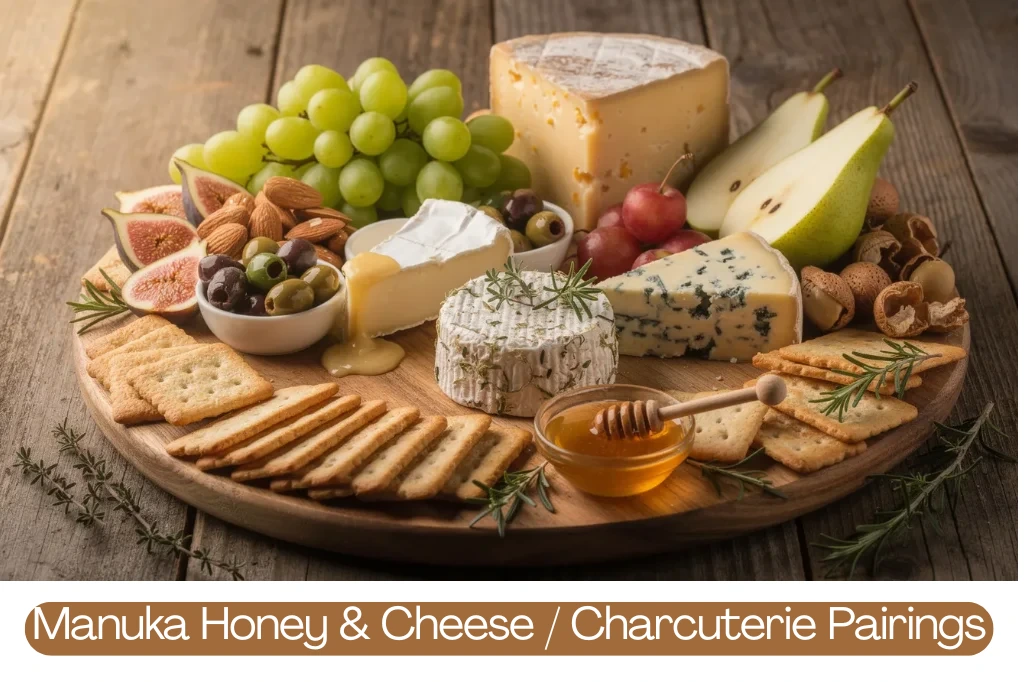
Manuka honey’s bold, earthy flavor suits strong, salty cheeses like blue, aged cheddar, and pecorino, and needs a lighter hand with delicate ones like brie. It works best drizzled on at serving time, in a small amount, so it complements the cheese instead of covering it.
The Rule: Match Intensity to Intensity
The pairing rule you’ll see everywhere is simple: mild cheeses take delicate honeys, and strong cheeses take bolder ones. What makes that useful for Manuka is knowing which group it belongs to. Manuka is thick, earthy, and sometimes slightly medicinal or bittersweet, especially at higher grades, which puts it firmly with the bold honeys, not the delicate floral ones. Higher-grade Manuka is often described as earthy and medicinal with caramel or toffee undertones, which matters below, because those undertones echo the nutty, caramel notes in aged cheddar and gouda.
UMF (Unique Manuka Factor) and MGO (methylglyoxal) are lab-tested markers used to grade Manuka honey, and higher grades are often, though not always, described as tasting stronger.
So the question for every cheese on the board is the same: can it stand up to that flavor, or will the honey take over? Everything below applies that one idea to Manuka specifically, not to honey in general.
The Pairings That Work
Drawn from Manuka’s flavor profile and published pairing guides, these combinations remain hypotheses until confirmed with tasting notes from a real board.
Blue Cheese
Blue cheese is salty, sharp, and pungent, and a bold honey has a better chance of holding its own against that than a mild one does. Manuka’s earthy, slightly bitter-sweet edge sits alongside the cheese’s intensity instead of disappearing into it, and the sweet-and-salty contrast does the rest.
Aged Cheddar and Gouda
Aged cheddar and aged gouda are nutty and often carry caramel notes of their own. Higher-grade Manuka is described by some brands as caramel- and toffee-like, so the honey echoes what’s already in the cheese rather than fighting it. Aged cheddar also shows up in guides for more formal boards as a reliable match for a stronger honey.
Pecorino and Parmesan
Both are salty, nutty, and firm, and one pairing guide specifically singles out pecorino’s salty, nutty profile as a good partner for Manuka. Shave it thin, add a small drizzle, and the salt keeps the honey from tasting too sweet.
The Pairings That Need Care
This is where the published advice genuinely disagrees, and it’s more useful to say so than to smooth it over.
Brie and Camembert
One guide warns that a strong, savory honey like Manuka can overpower delicate brie, and published advice on brie and honey varies, so this is a genuine judgment call. Both views can hold depending on grade and quantity. That fits the intensity rule: brie is mild and creamy, a high-grade Manuka (UMF 15+, roughly MGO 514+) is more likely to overwhelm it, while a lower grade (UMF 5+ to 10+, roughly MGO 83+ to 263+, an approximate conversion) with a very light drizzle is more likely to work.
Ricotta and Fresh Goat Cheese
Another source takes the opposite view on ricotta, liking Manuka there because its earthy depth adds complexity against the cheese’s plain sweetness. Both can be true: ricotta is plain enough to benefit from a little character, but also easy to overwhelm. Fresh goat cheese’s tang gives Manuka something to play against, so it tends to handle a bold honey better than ultra-mild ricotta does.
How to Serve It on a Board
A few practical habits keep Manuka from taking over the board:
- Serve it in a small dish with a spoon or dipper, so guests take what they want instead of the whole board getting drizzled.
- Drizzle at serving time if you’re finishing cheese yourself, so the honey doesn’t soak into crackers or bread.
- Start with a small amount. Manuka is stronger than most honeys, so a lighter hand than you’d use with a mild honey is a sensible starting point, then adjust to taste.
- Swap it in one to one for another honey on a board, but start with less honey by volume, since the flavor is stronger, and add more to taste. One to one means the same role on the board, not the same amount.
- Let it come to room temperature. Thick honey drizzles and spreads more easily when it isn’t cold.
Warm Cheese and Heat
Baked or warmed brie is a classic, and honey on top is the usual finish. Manuka is one of the few times heat matters on a cheese board. Published testing found MGO showed little loss in a 10-minute test up to about 90°C, was significantly reduced above about 100°C, and dropped sharply at higher oven-type temperatures (roughly 12% left after 10 minutes at 150°C). Related research found some loss under other 90°C conditions too, so exposure time matters as well as temperature. Sustained high heat reduces the compound Manuka’s grades are built around.
The practical move is to bake or warm the cheese first, then drizzle the Manuka on once it’s out of the oven and warm rather than scorching hot. You still get the flavor, the sticky-glaze look, and more of the honey’s original character than if it had baked in. The full heat explanation is its own topic, this is just the one place it changes what you do on a board.
Which Grade to Use on a Board
A lower-to-mid grade, UMF 5+ to 10+ (roughly MGO 83+ to 263+, an approximate conversion), is usually enough for a board, and it’s kinder to your budget too, since the honey is a garnish, not the main event. Higher grades read stronger and can overwhelm delicate cheeses, and how the flavor changes grade by grade is worth a look before you pick. A milder raw honey can share the board as a contrast, especially next to the delicate cheeses. Our full guide to cooking with Manuka covers grade choice in the kitchen more broadly.
FAQ
Can I use regular honey instead?
Yes, and for delicate cheeses like brie or fresh goat cheese, a milder honey may actually suit them better. Manuka’s advantage on a board is boldness, so it earns its place next to strong, salty, or nutty cheeses, not everywhere.
Should the honey be room temperature?
Generally, yes. Cold honey is thick and hard to drizzle, so let it sit out for a bit before serving. There’s no need to warm it up, room temperature is enough.
What else belongs on the board?
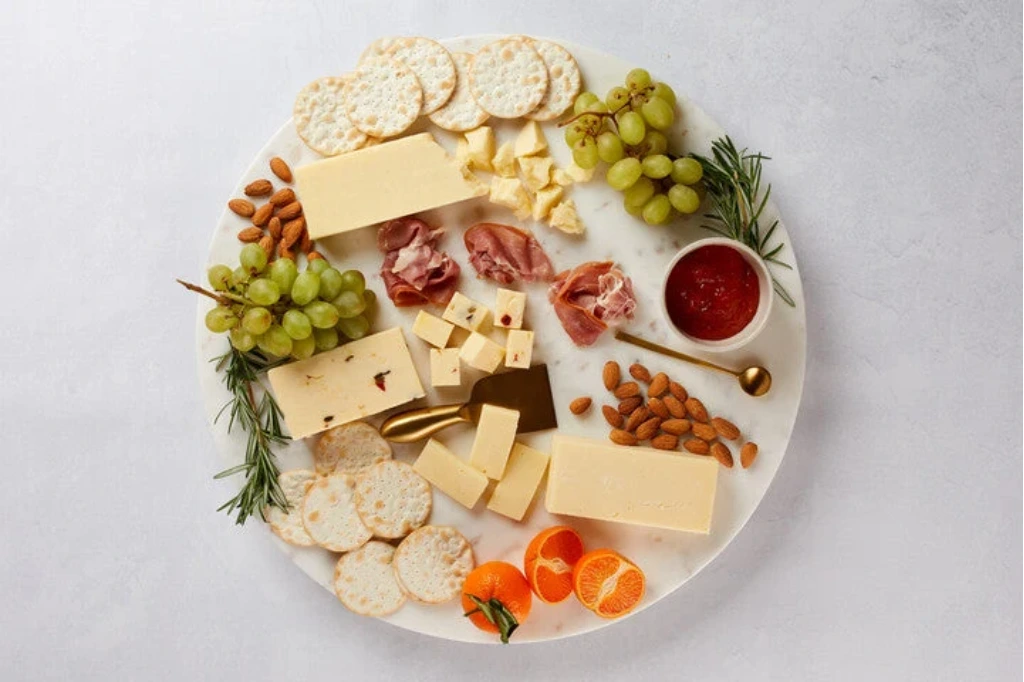
Things that echo or contrast with Manuka’s earthy sweetness: toasted nuts, figs or other fruit, and salty cured meats for a charcuterie board. Plain crackers or bread give the honey something neutral to sit on. These are standard, widely used board items, so they’re safe defaults whichever cheeses you choose.