
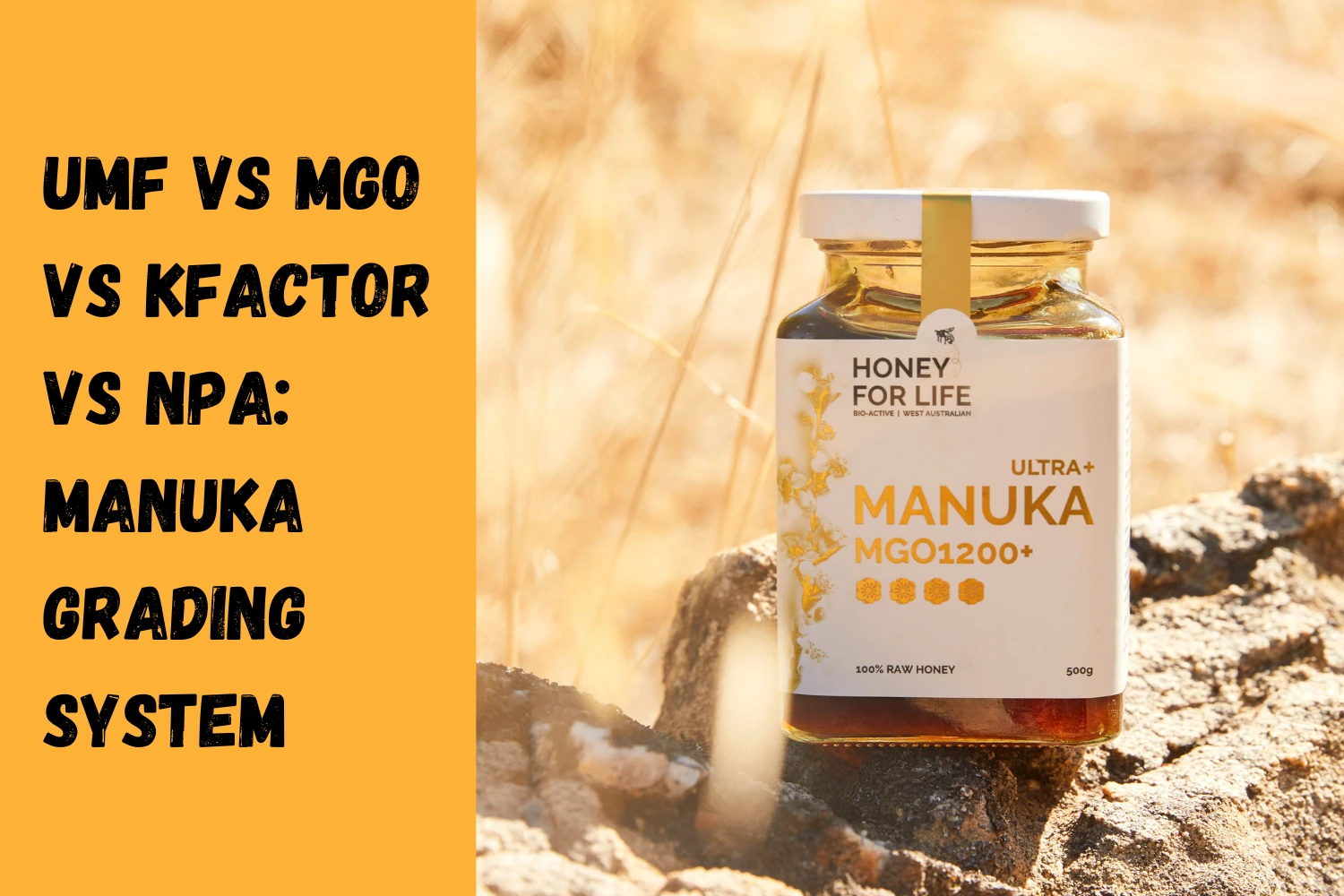
UMF, MGO, and NPA all trace back to the same antibacterial-activity discovery and convert directly, UMF 10+ works out to roughly MGO 263+. KFactor measures something else entirely, Manuka pollen count, and can’t be converted to any of the other three. Here’s how all four actually relate to each other.
| UMF | MGO | KFactor | NPA | |
|---|---|---|---|---|
| What it measures | Four markers together (MGO, leptosperin, DHA, HMF) | Methylglyoxal only | Manuka pollen percentage | Non-peroxide antibacterial activity |
| Confirms potency? | Yes | Yes | No | Yes |
| Confirms genuine Manuka origin? | Yes, via leptosperin | No, on its own | Yes, via pollen | No, on its own |
| Convertible to UMF? | N/A | Yes, directly | No | Yes, nearly 1:1 |
| Checkable via a public license lookup? | Yes, UMFHA | No | No | No |
| Typically seen on | Comvita and other UMFHA-licensed brands | Manukora and other MGO-only brands | Wedderspoon | Older or UK-market labels |

UMF vs MGO: One Lineage, Two Labels
The most common source of confusion on this whole topic is treating UMF and MGO as two competing systems. They’re not. MGO is a single compound, methylglyoxal, measured directly in milligrams per kilogram. UMF is a broader certification that tests four markers together:
- Methylglyoxal (MGO): the compound itself, the same one a standalone MGO number measures
- Leptosperin: an authentication marker that confirms genuine Manuka origin
- DHA: the precursor compound that converts into MGO as honey matures in storage
- HMF: a freshness marker that flags heat or age damage
That means a UMF grade is confirming more than a raw MGO number can on its own. A jar labeled MGO 263+ tells you the methylglyoxal level and nothing else. A jar labeled UMF 10+ tells you that same MGO level plus verified origin and a freshness check, backed by a checkable UMFHA license number. Neither claim is fake, they’re just answering different-sized questions.
Here’s a concrete way to see the gap: two jars could both test at roughly 263 mg/kg of methylglyoxal. One carries a UMF 10+ certification because it also passed the leptosperin and HMF checks. The other only lists MGO 263+, because the brand chose to test and certify MGO alone rather than pursue the full UMF process. Both honeys may have essentially the same antibacterial compound level. Only one of them has independently confirmed that the honey is genuinely Manuka and hasn’t been heat-damaged since testing. That’s the actual difference, not a potency gap, a verification gap.
If you want the full tier-by-tier breakdown of what each UMF number guarantees, here’s the full UMF tier breakdown from 5+ to 24+. If your jar shows a standalone MGO number instead, here’s how MGO is measured and what drives its price.
What About NPA?
This is the one system with no dedicated deep-dive page anywhere else in this cluster, so it’s worth covering properly here rather than in one throwaway line. Here’s the actual timeline:
- Early 1980s: Professor Peter Molan at the University of Waikato was studying honey’s antiseptic properties, which in most honey come from hydrogen peroxide. He found that Manuka honey kept a strong antibacterial effect even after the hydrogen peroxide was neutralized in testing, using an agar diffusion assay compared against phenol solutions as a reference.
- Naming the discovery: Molan called this leftover, unexplained effect non-peroxide activity, NPA, expressed on a phenol-equivalent scale, an NPA 10+ honey showed roughly the same antibacterial strength as a 10% phenol solution. He named the overall approach the Molan Gold Standard, and coined the friendlier term Unique Manuka Factor, UMF, for that same underlying discovery. NPA and UMF started as two names for the same thing, not two separate inventions.
- 1998: An industry group, the predecessor to today’s UMFHA, registered UMF as an exclusive trademark, restricting official use of that specific name to licensed members. Producers outside that licensing group kept using the older term NPA to describe the same kind of activity measurement, which is part of why you’ll still see NPA on some labels, more often in UK-market products, today.
- Mid-to-late 2000s: Professor Thomas Henle at the Technical University of Dresden led the research identifying methylglyoxal as the specific compound responsible for this activity, giving the industry a directly measurable chemical marker instead of only a biological assay.
- Since then: UMF certification has measured MGO directly, on top of the other three markers, rather than relying only on the original phenol-equivalent test.
Practically, UMF and NPA numbers track closely enough to be treated as nearly interchangeable, a UMF 10+ and an NPA 10+ are describing essentially the same activity level. If you see NPA on a label today, it’s a legacy naming choice more than a meaningfully different measurement, worth checking for real testing behind it the same as any UMF or MGO claim, not a reason to dismiss it outright.
Why KFactor Stands Apart
KFactor, used on Wedderspoon’s labels, is the one system on this page that genuinely doesn’t belong on the same scale as the other three. It measures Manuka pollen percentage, a botanical purity marker, not antibacterial activity at all.

Because it’s not measuring the same underlying property, there’s no honest conversion between a KFactor number and a UMF, MGO, or NPA number. A KFactor 16 jar might carry any MGO level, high or low, since the number simply isn’t answering that question. Here’s what Wedderspoon’s KFactor system does and doesn’t prove in full detail.
The UMF to MGO Conversion Table
Since UMF and MGO measure the same underlying compound, they do convert, and this table is checked against multiple current retail listings and the UMF Honey Association’s own published anchor points, not a single source or a guess.
| UMF Grade | Approximate MGO Equivalent |
|---|---|
| 5+ | 83+ |
| 10+ | 263+ |
| 15+ | 514+ |
| 18+ | 696+ |
| 20+ | 829+ |
| 25+ | 1,200+ |
The relationship isn’t a straight line. MGO doesn’t climb at a steady rate as UMF increases, it accelerates. The jump from UMF 20+ to UMF 25+ adds roughly 370 mg/kg of MGO, more than the entire MGO content of a UMF 5+ jar. That acceleration is a big part of why the top tiers get disproportionately more expensive, not just modestly pricier.
KFactor has no row here. It isn’t convertible to this scale at all, covered above.
Comvita sells across nearly this entire range, from UMF 5+ up to their UMF 25+ line, which makes their own labeling a useful real-world check against this table. I’ve cross-referenced these figures against actual jars on the shelf, not just compiled them from other explainer pages.
Using this table is straightforward once you have it in front of you. If you’re comparing a Comvita UMF 15+ jar against a Manukora jar labeled MGO 550+ instead of a UMF number, this table tells you the Manukora jar sits just below the UMF 15+ equivalent (MGO 514+) and meaningfully below UMF 18+ (MGO 696+), even though neither label uses the same terminology. That’s the actual comparison happening whenever you’re standing in front of two jars using different systems, not a guess about which “sounds” more potent.
If you’re trying to work out what a specific number should actually cost, not just what it means, here’s what you should actually pay at each grade in 2026.
Which System Should You Trust When Buying?
Trust breaks down differently for each system:
- UMF: carries the strongest built-in verification, four tested markers plus a specific, checkable UMFHA license number tied to the brand.
- MGO alone: not automatically fake without UMF backing, but worth more scrutiny, since it hasn’t gone through the same authentication step for leptosperin and freshness.
- KFactor: requires a different kind of trust entirely, understanding that it’s answering a botanical-origin question, not a weaker version of the potency question UMF and MGO are answering.
- NPA: worth the same scrutiny as any UMF or MGO claim, the naming is older, not necessarily less rigorous, but it depends entirely on whether that specific producer actually tested for it.
None of these labels are worth taking at face value without checking the certification behind them. A trustworthy jar, regardless of which system it uses, should have some form of checkable evidence behind the number, a UMFHA license, a batch certificate, or at minimum a named, contactable producer. Our full label verification checklist for spotting fakes and how to verify a UMFHA license step by step both walk through that process directly.
FAQ
Is a higher MGO always better than a lower UMF from a different brand?
Not necessarily. A standalone MGO number only confirms methylglyoxal content, while a UMF grade confirms that plus origin and freshness. A high MGO claim from an unverified brand isn’t automatically more trustworthy than a lower UMF grade with a real, checkable license behind it.
Can a jar have a KFactor number and a UMF number at the same time?
In practice, no, since KFactor is Wedderspoon’s own proprietary system and UMF is restricted to UMFHA licensees. A single jar typically carries one labeling system or the other, not both, though a brand could theoretically hold both certifications if they chose to pursue them.
Is NPA still used today, or is it outdated?
It’s still used, mostly on UK-market labels and by producers outside the UMFHA licensing group, but it’s largely redundant where a UMF number is already present. NPA and UMF numbers are nearly interchangeable in practice, so it’s a legacy naming choice more than a meaningfully different or outdated measurement.