
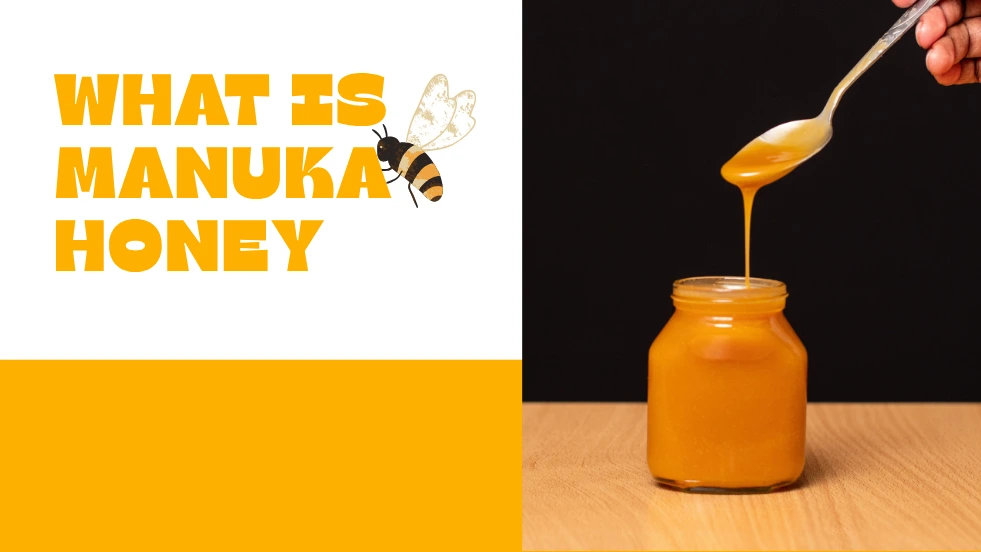
Manuka honey is a monofloral honey made from the nectar of the Manuka tree, native to New Zealand and parts of Australia. It’s valued for its methylglyoxal (MGO) content, graded by systems like UMF and MGO, and genuine jars can be verified through a UMFHA license number check.
Where Manuka Honey Comes From
Manuka honey comes from bees foraging on Leptospermum scoparium, a flowering shrub native to New Zealand and parts of Australia. The tree blooms for just a few weeks each summer, which is part of why Manuka honey costs more than a standard wildflower or clover honey, there’s a narrow window each year to actually harvest it, and beekeepers often move hives into remote terrain specifically to reach it.
New Zealand’s Ministry for Primary Industries (MPI) maintains the official scientific definition used to confirm a honey qualifies as genuine Manuka for export and labeling there. You’ll also see it described as monofloral (bees foraged predominantly on Manuka) or multifloral (blended with other nearby nectar, generally lower and less consistent in methylglyoxal). Whether Australian-grown Manuka should count the same way New Zealand-sourced Manuka does is a separate, ongoing debate in the industry.
What Makes Manuka Honey Different From Regular Honey
Manuka honey differs from regular honey in one core way: methylglyoxal, a compound that occurs at unusually high, measurable levels in genuine Manuka honey and doesn’t show up in meaningful amounts in a standard wildflower or clover honey. That single difference is what drives everything else about how Manuka gets treated compared to other honey:

- Testable and gradable, since methylglyoxal is a specific compound that shows up in a lab result, not a subjective quality claim
- Backed by certification bodies like UMFHA, because a compound-level claim needs independent verification the way a plain honey label doesn’t
- Priced significantly higher, often several times the cost of wildflower or clover honey, reflecting both scarcity and the testing behind it
I buy a jar and cross-check its UMFHA license before I ever recommend one, because that price gap only makes sense if the jar is actually what it claims to be.
The Grading Numbers at a Glance (UMF, MGO, KFactor, NPA)
A handful of numbers and letters show up on Manuka labels, and they’re not all measuring the same thing, which is exactly where a lot of buyer confusion starts.
MGO is the compound itself, methylglyoxal, measured directly in milligrams per kilogram of honey. A jar labeled MGO 100+ has at least that much methylglyoxal per kilogram, tested directly rather than estimated. It’s a straightforward, single-number claim, which is part of why some brands sell honey under an MGO number alone without a broader certification attached.
UMF, used by brands like Comvita, is a certification that verifies MGO alongside leptosperin, an authentication marker that confirms genuine Manuka origin, and DHA, the precursor compound that converts into MGO as the honey sits in storage. A UMF number is a broader certification than a raw MGO number by itself, since it’s confirming more than one marker at once, and it comes from an industry association rather than a single brand’s own internal testing.
KFactor, used on Wedderspoon’s labels, measures something different entirely: pollen count, not methylglyoxal or leptosperin. Because it’s measuring a separate thing, a KFactor number doesn’t convert directly into a UMF or MGO number, which is a common point of confusion worth knowing before you try to compare two jars that use different systems side by side. Seeing a KFactor 16 on one jar and a UMF 10+ on another doesn’t tell you which one has more methylglyoxal, since the two numbers aren’t answering the same question in the first place.
NPA (non-peroxide activity) describes roughly the same underlying antibacterial concept UMF and MGO are getting at, expressed on its own scale, and it’s an older term that predates UMF as a standardized system. You’ll still see it referenced occasionally, usually on jars from brands that established their labeling before UMF became the more widely adopted standard. HMF is different again, a marker that signals heat or age exposure rather than potency, a high HMF reading means a jar has likely taken on damage somewhere along the way, regardless of what its grade number says on the front of the label.
That’s the landscape at a glance, enough to make sense of a label without getting lost in it. Our full comparison of UMF, MGO, KFactor, and NPA walks through how each system actually works, how they roughly convert to each other, and which one to trust when a jar shows more than one number.
How to Know If a Jar Is Genuine (Verification Basics)
The single most useful thing to check on a jar is its UMFHA license number, a specific, verifiable number tied to the brand rather than a general logo or seal. A genuine jar carries a license number that can actually be looked up against UMFHA’s own records, not just a UMF-style label printed without one behind it. This matters more than it might seem, since honey in general has a well-documented history of fraud and mislabeling, and a graded product with a real price premium attached is worth more to fake convincingly than a plain jar of wildflower honey is.

A UMFHA license number verifies the brand behind the jar. It doesn’t, by itself, confirm that the specific jar in your hand is from a clean, untampered batch, that’s a separate check involving the batch certificate printed alongside the license number. The two checks work together rather than one standing in for the other, which is worth knowing before assuming a license number alone settles the question, especially given how much a genuine, high-grade jar actually costs.
This is the first thing I check before I ever taste or recommend a jar. It doesn’t replace a full label and batch certificate check, but it’s the quickest single way to tell whether a jar is worth looking into further or worth skipping entirely, especially if you’re standing in a store trying to decide between two jars on the shelf.
Where to Go Next
That’s the basic picture: what Manuka honey is, where it comes from, and what the numbers on the label are actually measuring. Where you go from here depends on what actually brought you to this page:
- Want to compare the grading systems? See how UMF, MGO, KFactor, and NPA stack up against each other in the section above, including how the different scales roughly convert. That’s the right stop if you’ve got a jar in hand and are trying to make sense of its specific number.
- Wondering what a fair price actually looks like? Here’s the full price guide by grade, based on real, current listings rather than a round estimated number.
- Want to see specific brands ranked? See how the top Manuka brands compare, not just the grading systems in the abstract.
- Trying to verify a jar you already own? Checking a UMFHA license, reading a batch certificate, or spotting a fake label is a deeper walkthrough than this page covers, and it has its own dedicated page on this site.
- Curious about origin or floral type? The New Zealand-versus-Australia debate and the monofloral-versus-multifloral distinction are both their own topics, with more room to do them justice than a single section here.
- Just wanted the basics? You’ve got them. There’s nothing else you need to go read before deciding whether to try Manuka honey.