
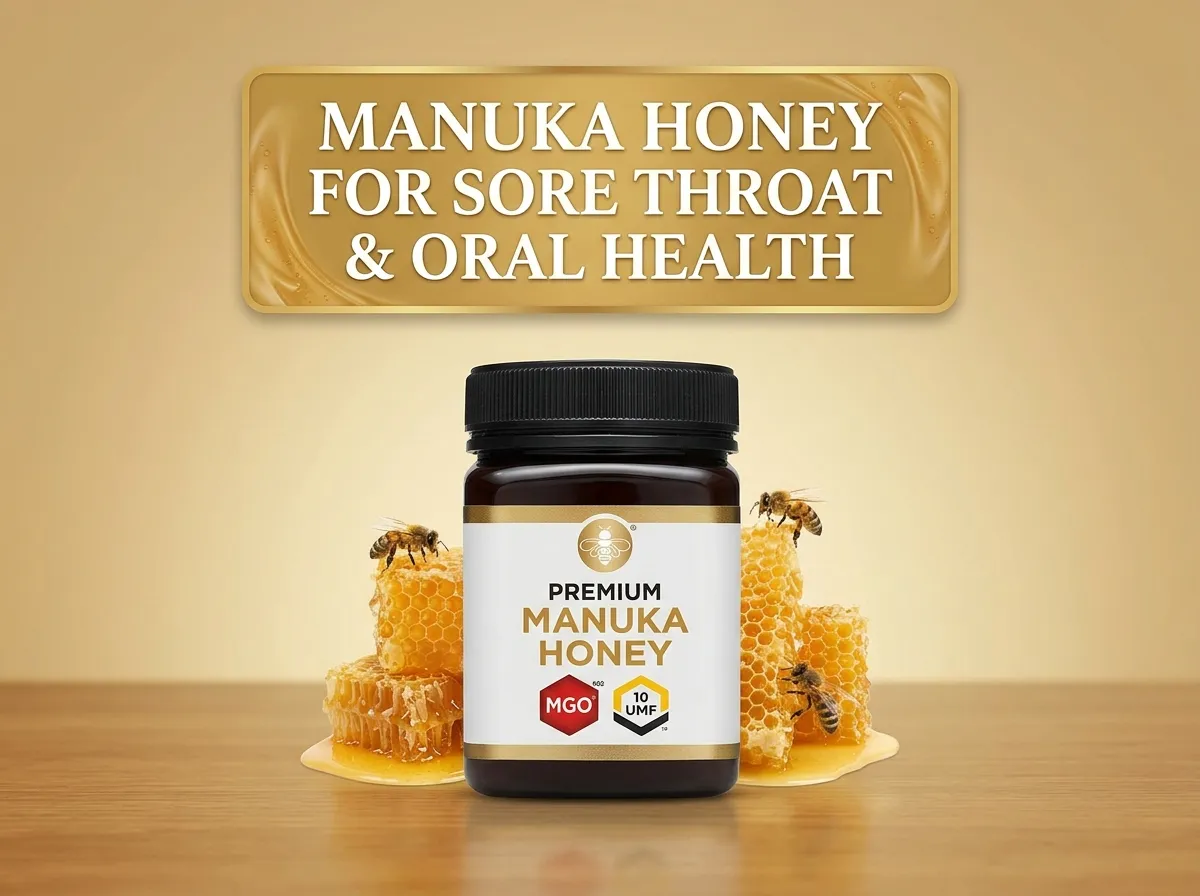
Honey has genuine systematic-review-level evidence for easing cough and upper respiratory symptoms in children over 12 months, the strongest evidence base anywhere in this site’s health content. Most of that evidence studied honey generally, not Manuka specifically. Honey of any kind should never be given to a child under 12 months old.
What the Evidence Actually Shows
Research indicates that honey can help relieve cough and upper respiratory tract symptoms, particularly in children, performing similarly to or better than some common over-the-counter alternatives. However, evidence regarding its direct impact on sore throat recovery is more limited, and clinical trials have not established superior efficacy for specific high-potency Manuka grades over standard honey.
Key Evidence Points
- Cough Reduction (Cochrane Review, 2018):
- A Cochrane review analyzing 6 trials with roughly 900 children (ages 12 months to 18 years) concluded with moderate certainty that honey probably reduces cough symptoms more than no treatment.
- Honey showed little or no difference when compared to dextromethorphan (a common cough suppressant).
- Honey may outperform diphenhydramine (an antihistamine), though this specific finding is based on low-quality evidence.
- Upper Respiratory Symptoms & Sore Throat (BMJ Review, 2020):
- A meta-analysis of 14 trials found honey was superior to usual care for overall upper respiratory tract symptoms, cough frequency, cough severity, and fever recovery by day 5.
- Notably, honey was not shown to be superior to usual care specifically for throat pain recovery by day 5.
- Cough & Sleep Quality in Children (Pediatrics Trial, 2012):
- A randomized, placebo-controlled trial of 300 children (ages 1 to 5) comparing a single bedtime dose of honey versus a placebo (date extract) found honey significantly improved cough frequency, cough severity, and sleep quality.
- Potency & Grading (UMF/MGO):
- While Manuka honey’s methylglyoxal (MGO) content gives it antibacterial properties in laboratory settings, no clinical trial for cough or sore throat has compared one UMF or MGO grade against another.

Honey is an effective, evidence-backed option for easing coughs and upper respiratory symptoms, performing comparably to standard OTC cough suppressants. However, direct evidence does not show it accelerates sore throat pain recovery compared to usual care, nor does clinical research prove that higher UMF or MGO grades offer superior relief for these symptoms.
Honey Generally vs Manuka Specifically
This is the distinction that matters most on this page. The Cochrane and BMJ reviews above studied honey as a category, not Manuka specifically, most of the honey used in these trials was common varieties like buckwheat, eucalyptus, citrus, or labiatae honey, not Manuka. The systematic-review evidence genuinely supports “honey helps with cough and upper respiratory symptoms,” but it doesn’t specifically support “Manuka honey is better than other honey for this use.”
Manuka’s methylglyoxal content gives it documented antibacterial activity in lab studies, a real and plausible added property. But that specific added value hasn’t been isolated and tested head-to-head against other honey types in the same cough and throat trial designs covered above. If you’re choosing Manuka for a sore throat specifically because you expect it to outperform a cheaper honey, that expectation is reasonable as a hypothesis, not something these trials have confirmed.
What Studies Actually Used
Across the cited pediatric trials, amounts generally fell in the 1 to 2 teaspoon (5 to 10 mL) range, with the 2012 Pediatrics trial using a single 10-gram dose, roughly two teaspoons, before bed. This is what the studies used, not a dosing recommendation for you to follow. How much to actually take and when covers practical dosing guidance in full, this page is just reporting what the research itself used.
The One Hard Rule: No Honey Under 12 Months
Honey of any kind, including Manuka, should never be given to a child under 12 months old. This is due to the risk of infant botulism, a well-established pediatric safety rule, and it applies regardless of the honey’s grade, price, or any claim made about it. This also applies to all forms of honey, including in teas, lozenges, baked goods, and honey-flavored medicines, not just a spoonful on its own.
FAQ
Does a higher Manuka grade work better for sore throat?
That’s not established by any clinical trial. No study covered here tested one UMF or MGO grade against another for cough or sore throat relief, so a higher grade is a preference, not a proven advantage for this specific use.
Is honey better than over-the-counter cough medicine?
The evidence is mixed and comparison-specific. The 2018 Cochrane review found little or no difference between honey and dextromethorphan, while honey may outperform diphenhydramine specifically, these are different comparisons with different results, not a blanket “honey wins.”
When should I see a doctor instead of using honey?
A persistent or severe sore throat, one accompanied by fever or difficulty swallowing, symptoms lasting more than 3 to 5 days, or sore throats that keep recurring, all need a clinician rather than a home remedy. Our full evidence-graded look at Manuka honey’s health claims covers other specific claims with the same sourcing standard, and more on how our health content is verified and reviewed explains this site’s approach to evidence-based coverage generally.