
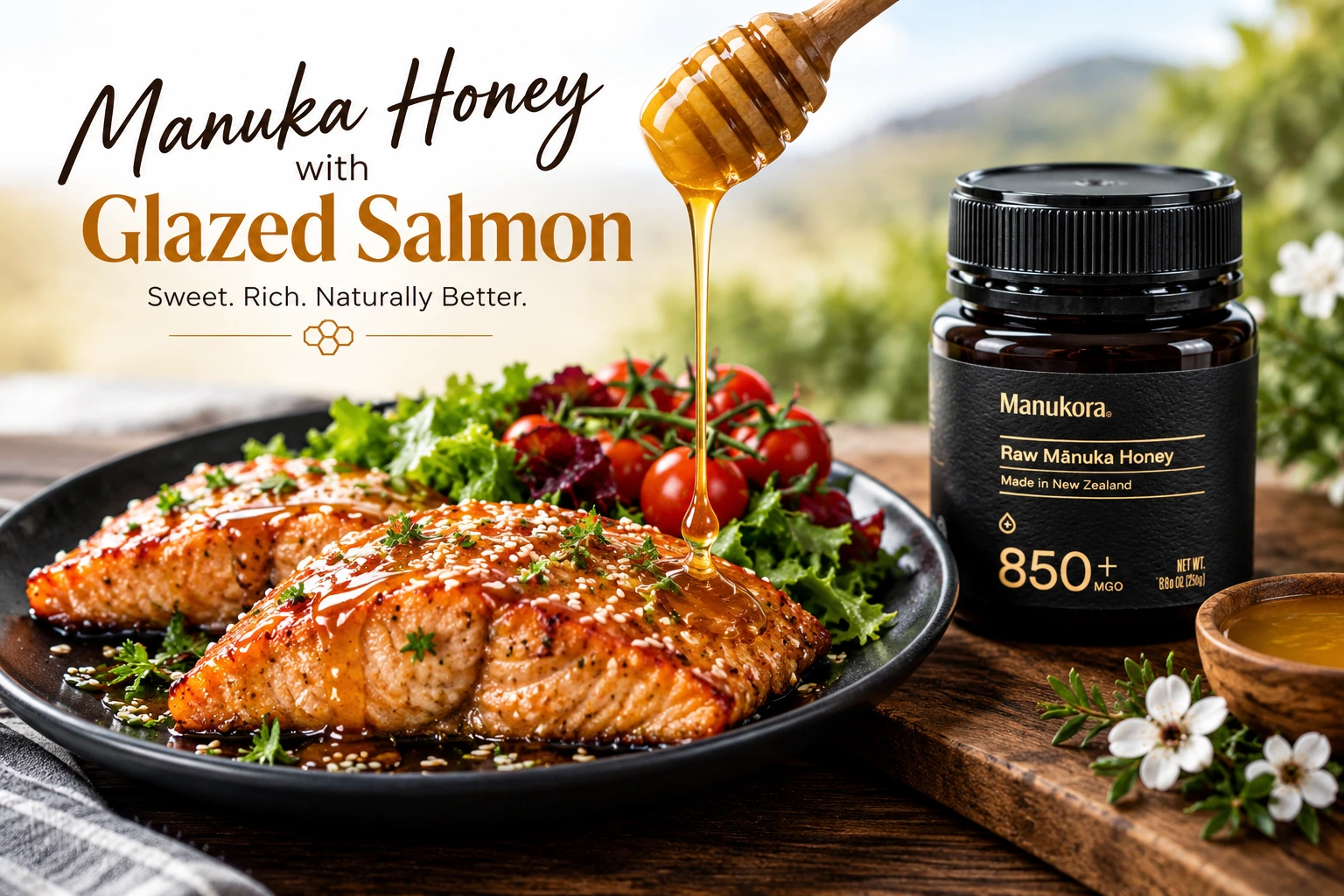
Bake the salmon plain at 400°F until it hits 145°F, then spoon a cold Manuka honey, garlic, and lemon glaze over the top once it’s out of the oven. The honey keeps its flavor, nothing scorches, and dinner comes together on one sheet pan.
Most honey glazed salmon bakes the honey right onto the fish, which is a rough deal for an expensive jar of Manuka, and also how honey ends up scorched. This version does it backwards. The salmon bakes plain, and the glaze goes on afterward, so the honey never sees the oven.
Yield: 4 servings. Bake time: about 12 to 15 minutes
Why You’ll Love This Manuka Honey Salmon
- One sheet pan and no stovetop. The glaze is whisked cold in a bowl, so nothing simmers, and there’s no sauce to babysit while the fish bakes.
- The honey tastes like honey. Added after baking, it keeps the earthy Manuka flavor instead of turning into caramelized sugar.
- A cheaper jar works fine. A lower-to-mid grade is plenty here, since you’re buying flavor, not potency.
- The glaze does double duty. Save a spoonful to drizzle over rice or greens.
- It’s a short bake. Fillets about an inch thick generally need roughly 12 to 15 minutes at 400°F.

Ingredient Notes & Substitutions
Salmon: four fillets, about 5 to 6 ounces each and roughly 1 inch thick. Even thickness matters more than skin on or off, since it’s what makes the fillets cook at the same pace. If yours are frozen, thaw them fully first.
Manuka honey: a lower-to-mid grade, roughly UMF 5+ to 10+, is plenty here. The glaze goes on after cooking, so a premium jar adds cost you won’t taste against garlic, soy, and lemon.
Regular raw honey: swap one to one by volume. You lose the Manuka flavor, not the recipe. The full swap math lives on its own page.
Soy sauce: low-sodium, so the glaze doesn’t tip too salty. Tamari works for a gluten-free version, just check the label. Coconut aminos are sweeter, so start with less honey and taste.
Lemon and garlic: fresh lemon juice and finely minced garlic, since the garlic goes into the glaze raw.
Why the Honey Goes On Last
There are two plain reasons. Heat reduces MGO, the compound Manuka’s grades are built around: published testing found little loss in a 10-minute test up to about 90°C, significant loss above 100°C, and roughly 12% left after 10 minutes at 150°C. A 400°F oven is well past all of that. The heat science is covered in full here.
The second reason is more practical. Honey’s sugars burn quickly in a hot oven, so a glaze baked onto the fish can scorch before the salmon is done. Adding it afterward avoids both problems.
How to Make Manuka Honey Glazed Salmon
PREP: Heat the oven to 400°F and line a sheet pan with parchment. Pat the fillets very dry, rub them with 1 tablespoon of olive oil, and season with salt and pepper.
BAKE: Bake for about 12 to 15 minutes, depending on thickness, until the thickest part reads 145°F on a thermometer, which is the USDA’s safe minimum for fish. Treat the time as a starting point, since thickness, whether the fish went in chilled or at room temperature, and how your oven runs all change it. If the fillets are thinner than 1 inch, start checking at about 10 minutes. If they’re thicker, add 2 to 4 minutes and let the thermometer decide.
MAKE THE GLAZE: While the fish bakes, whisk 2 tablespoons of Manuka honey with 1 tablespoon of low-sodium soy sauce, 1 tablespoon of lemon juice, 2 minced garlic cloves, and a pinch of black pepper. No heat at all, just a bowl and a whisk. That makes about 1/4 cup of glaze, enough to lightly coat four 5 to 6 ounce fillets. Double it if you like extra for rice or greens.
GLAZE AND REST: Let the salmon rest for 2 to 5 minutes, then spoon the glaze over the top. Spoon any glaze that pools on the pan back over the fish, and save a little to drizzle over rice or greens.
Tips for the Best Glazed Salmon
- Pat the fillets dry. Wet fish steams instead of roasting, and the glaze slides off a damp surface.
- Use a thermometer. Thickness varies too much for a timer alone to be reliable, and 145°F is the number to watch.
- Whisk the honey into the soy and lemon first. Thick honey loosens into the liquid, so it spoons on evenly instead of clumping.
- Don’t simmer the glaze. Keeping it cold is the whole idea. Heating it defeats the purpose.
- Don’t skip the rest. Even a couple of minutes lets the surface cool a little, so the glaze clings instead of running straight off.
- Serve it with rice or greens. A side salad with goat cheese or crumbled feta also works if you’d like something tangy next to the sweet-salty glaze.
Variation to test: if you want a caramelized top, brush a thin coat of regular honey on in the last 2 to 3 minutes of baking, or broil briefly instead, then finish with the cold Manuka glaze once the fish is out and rested.
Storage & Reheating
Fridge: Refrigerate leftovers within 2 hours, in an airtight container. The USDA says cooked fish keeps 3 to 4 days in the refrigerator. If you’ve already spooned glaze over the salmon, refrigerate the glazed portion as is and use it within that same 3 to 4 day window, it doesn’t get its own separate shelf life. Store any unused glaze separately in a small covered container if you’d rather keep it longer than the fish.
Reheating: Warm the salmon gently, covered, in a low oven at about 300°F, checking at around 8 minutes. Time will vary with portion size and how full the dish is, so go by temperature, not the clock, and warm it until the thickest part reaches 165°F, which is the USDA’s guidance for reheating leftovers. Add fresh glaze after reheating rather than relying on what’s already on the fish.
FAQ
Can you cook salmon with Manuka honey?
Yes. The trick is to add the honey after the salmon comes out of the oven, not before, so it doesn’t scorch and keeps its flavor. If you want a caramelized top, you can brush a thin coat of regular honey on during the last couple of minutes of baking, then finish with the cold Manuka glaze once it’s out and rested.
When should I add Manuka honey to salmon?
After baking, once the fish has rested for a couple of minutes. Whisk the glaze cold and spoon it on at the end.
What grade of Manuka honey should I use in a glaze?
A lower-to-mid grade, roughly UMF 5+ to 10+, is plenty. A premium grade costs more without adding anything you’ll taste against garlic, soy, and lemon.
Can I use regular honey instead of Manuka?
Yes, swap it one to one by volume. The salmon will still taste good, you just lose the earthier Manuka flavor.
How do I know when the salmon is done?
Use a thermometer and look for 145°F in the thickest part, which is the USDA’s safe minimum for fish. Some cooks pull salmon a bit earlier, closer to 125 to 140°F, for a softer, more medium texture, but 145°F is the conservative guideline that ensures it’s fully cooked. The flesh should also flake easily with a fork.
If you make this and have a quick second to rate it, I would appreciate it so much! It really helps my little website. Thank you!
More Manuka Recipes
Want more ways to cook with Manuka without wasting the jar? Our full guide to cooking with Manuka honey covers which grade to use, how heat behaves, and more recipes to try.