
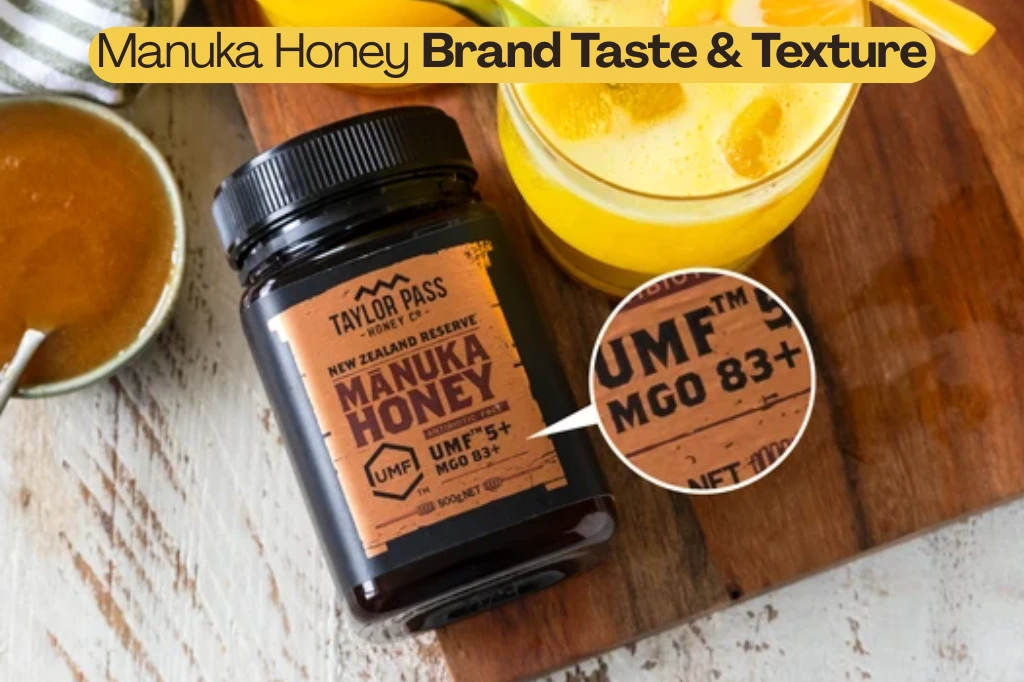
Manuka honey doesn’t taste or feel identical across brands, grades, batches, or storage conditions. Common descriptions range from smooth and creamy to thick and lightly granular, while flavor may include floral, earthy, herbal, caramel, toffee, or medicinal notes. Higher UMF or MGO grades often taste more intense within a brand, but that’s a tendency, not a guaranteed rule.
The comparison below is based on brand descriptions and dated third-party reviews, not a controlled side-by-side tasting. Until the same grades from all four brands are tasted under matching conditions, treat the brand conclusions as provisional sensory patterns, not firsthand test results.
What “Bitter” Actually Means Here
Genuine Manuka honey can taste earthy, herbal, medicinal, or slightly bitter, particularly at higher grades, and that’s a normal sensory characteristic, not a defect. Some tasting commentary specifically associates a stronger bitter or metallic note with grades above roughly UMF 15+ or MGO 514+, bitterness by itself doesn’t prove a jar is old, damaged, or fake.
What’s actually worth paying attention to is a sour, fermented, alcoholic, or otherwise unpleasant smell or flavor, that’s a different thing entirely and can point to spoilage or moisture-related fermentation rather than a normal grade-related trait. If a jar smells or tastes off in that specific way, that’s worth checking against the best-before date and following up with the retailer or manufacturer, plain bitterness alone isn’t the red flag, an off, sour smell is.
How Grade Affects Flavor Within a Brand
Similar flavor tendencies are reported across many brands, lower grades often read lighter and sweeter, higher grades often read richer and more intense, but grading systems don’t determine taste on their own. The grade number reflects measured markers or activity associated with the honey, it doesn’t by itself prove the honey came from a more concentrated harvest, and harvest, origin, storage, and personal perception can all produce real exceptions to the general pattern.
The Brand-by-Brand Comparison
| Brand | Taste (as described/reviewed) | Texture (as described/reviewed) | Confidence |
|---|---|---|---|
| Comvita | Sweet, earthy, herbal, and more savory or intense at higher UMF grades | Dense, smooth, creamy, or velvety, crystallization may add graininess | Moderate |
| Manukora | MGO 600+: floral, light caramel, toffee. MGO 850+: richer caramel, toffee, slightly medicinal | Smooth, thick, and creamy | High for brand’s own descriptions |
| Wedderspoon | Earthy, caramelized-sugar notes reported | Smooth and creamy, some reviews call it thinner than chunkier competitors | Moderate |
| Egmont | Official language emphasizes caramel and golden sweetness, fuller flavor at higher grades | Smooth, creamy, semi-thick, or velvety depending on product and batch | Moderate |
Comvita
Comvita’s own material describes its honey as thick, dense, and velvety, with sweetness balanced by earthy, herbal, and slightly bitter notes. Lower-grade products are often described as smoother, sweeter, and easier to use daily, while higher grades are more likely to show savory, earthy, or medicinal notes, that’s Comvita’s own framing and reviewer commentary, not yet an independent test from this site.
Manukora
This is the best-supported brand section here. Manukora describes MGO 600+ as having light caramel and toffee notes with a deep floral flavor and a smooth, thick texture, and describes MGO 850+ as richer caramel and toffee with slightly medicinal notes and a smooth, creamy texture. Manukora is repeatedly described as smooth and creamy, especially at these two tiers, “whipped” is stronger wording than the available product descriptions actually support, so that’s been corrected here rather than repeated. Don’t treat MGO 600+ or 850+ as a fixed UMF equivalent without a reliable, clearly-labeled conversion, that’s a separate approximation, not the same claim as this taste comparison.
Wedderspoon
A review describes Wedderspoon’s KFactor 16 as smooth and creamy but somewhat thinner than chunkier Manuka honeys, while other listings describe earthy and caramelized-sugar notes. Wedderspoon’s KFactor label should not be treated as a flavor scale, KFactor is a botanical-purity and labeling system, while taste is driven by floral source, processing, storage, and batch, not the grading system itself. The sensory notes above are observations from available reviews, not a proven consequence of KFactor specifically.
Egmont
Egmont’s own official descriptions emphasize caramel sweetness and a smooth or velvety texture at UMF 5+, and rich, full-bodied caramel notes with a velvety texture at UMF 15+, though independent reviews range more widely, from semi-thick to relatively thin, depending on the specific product and batch. Egmont may offer strong value when its retail price undercuts larger brands, but that conclusion depends on the specific grade, jar size, retailer, and sale timing, not a fixed, provable flavor-to-price advantage.
Which One Should You Buy Based on Taste Alone?
Manukora has the clearest, most consistently documented smooth-and-creamy profile across sources. Egmont can look attractive for value specifically when its pricing undercuts the larger brands at a comparable grade. Based on the available descriptions and reviews, Comvita and Wedderspoon appear less clearly differentiated from each other by texture than Manukora is from either of them, but a controlled, same-day, same-grade tasting is still needed to confirm that impression rather than treat it as settled. How these brands rank overall, taste, price, and verification combined covers the fuller buying decision this page doesn’t.
FAQ
Why did my jar taste different from what’s described here?
Batch-to-batch variation is real and expected, hive location, nectar source, and how long the honey’s been sitting before you opened it can all shift flavor and texture, even within the same brand and grade. Crystallization specifically is a normal physical change, not a sign of poor quality on its own. Compare jars only when they’re the same grade, size, roughly the same age, and stored similarly, otherwise the batch difference may be larger than any real brand difference.
Which brand is best for someone new to Manuka honey?
Someone new to Manuka may prefer a lower-grade UMF 5+ or UMF 10+ jar from a reputable producer, these tend to be less expensive and less intense than higher grades. Comvita’s UMF 5+, described by the brand as versatile, smooth, creamy, and sweet, is one reasonable starting option, not the only one, taste preference is genuinely personal, and a smaller jar is a sensible way to try a grade before committing to a larger size.
Which texture is best for cooking or baking?
For cooking, texture is mainly a handling preference rather than a firm rule. Thicker honey may be easier to drizzle or use in a glaze, while a smoother, more fluid honey blends more quickly into dressings, drinks, and batters, though heating changes viscosity either way, so the starting texture often matters less once the honey’s actually incorporated into a finished dish. Here’s how to put these flavor differences to work in a recipe, in more depth than this page covers.