
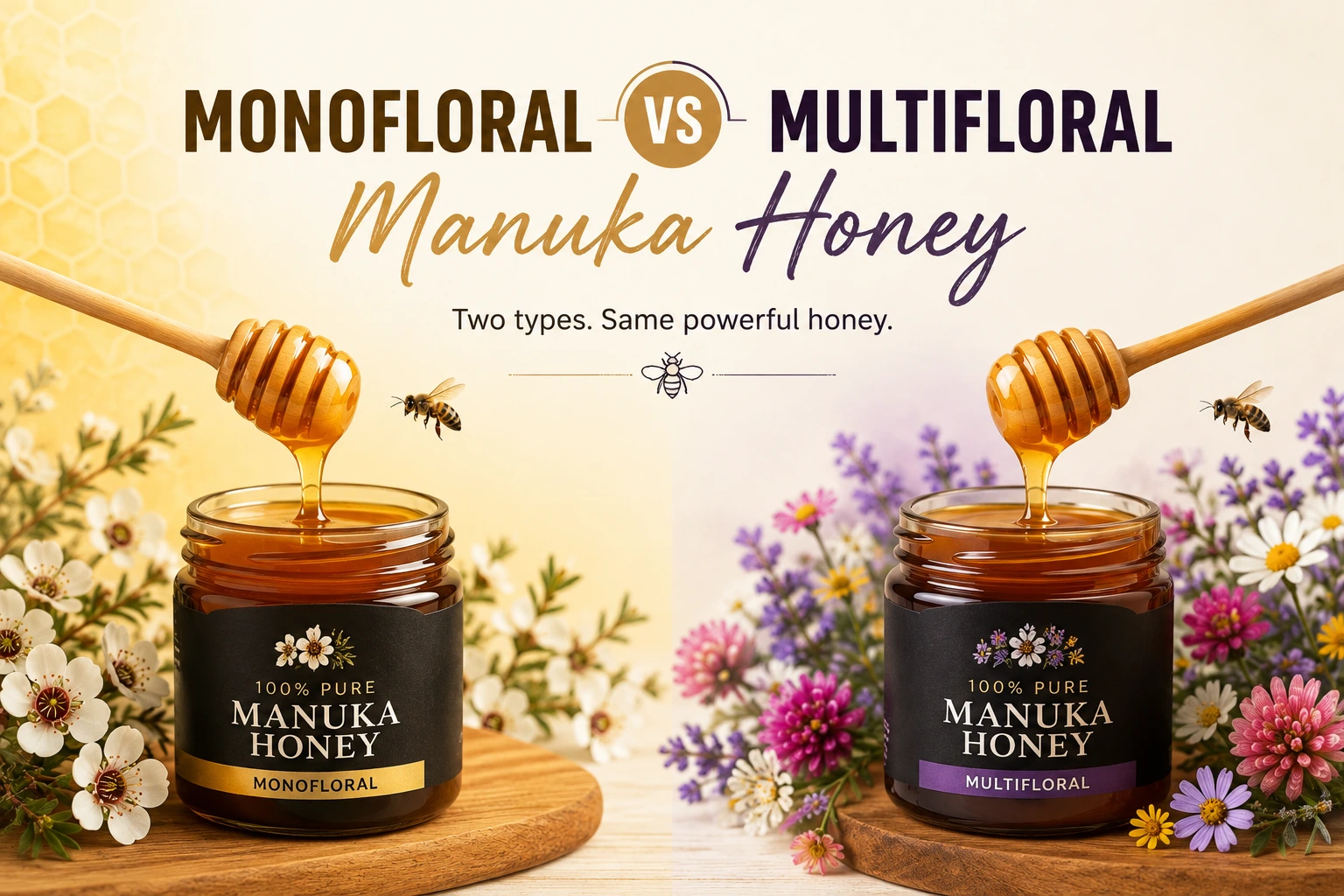
Monofloral Manuka honey requires a 3-phenyllactic acid level of 400 mg/kg or higher, while multifloral requires 20 to 399 mg/kg, both alongside the same pollen DNA marker and two other chemical markers. Both are legitimate, MPI-recognized Manuka classifications, multifloral isn’t a diluted or lesser version.
The Actual Threshold That Separates Them
New Zealand’s MPI defines the line with real numbers, not a vague “more concentrated” description. Monofloral Manuka requires 3-phenyllactic acid at 400 mg/kg or above, plus 2′-methoxyacetophenone at 5 mg/kg or above, with 2-methoxybenzoic acid and 4-hydroxyphenyllactic acid each at 1 mg/kg or above. Multifloral requires the same three supporting markers, but 3-phenyllactic acid only needs to fall between 20 and 399 mg/kg.
| Marker | Monofloral Requirement | Multifloral Requirement |
|---|---|---|
| 3-phenyllactic acid (3-PLA) | ≥ 400 mg/kg | 20 to 399 mg/kg |
| 2′-methoxyacetophenone (2′-MAP) | ≥ 5 mg/kg | ≥ 1 mg/kg |
| 2-methoxybenzoic acid (2-MBA) | ≥ 1 mg/kg | ≥ 1 mg/kg |
| 4-hydroxyphenyllactic acid (4-HPLA) | ≥ 1 mg/kg | ≥ 1 mg/kg |
| Manuka pollen DNA | Below Cq 36 (≈ 3 fg/µL) | Below Cq 36 (≈ 3 fg/µL), same threshold |
Both classifications require the identical pollen DNA marker, tested the same way regardless of which floral category the honey ends up in. The DNA test confirms the honey came from Manuka. The 3-phenyllactic acid level is what actually separates monofloral from multifloral. Leptosperin, the marker UMFHA checks for UMF certification, is a separate compound entirely, tested under a different system for a different purpose, it plays no role in the MPI mono/multi cutoff at all.
What to actually check on a label: whether it states “Monofloral” or “Multifloral” outright. Not every brand prints this explicitly, and its absence isn’t automatically a red flag, but if a jar does make a specific mono/multi claim, that claim is what the thresholds above are verifying, not the UMF or MGO number sitting next to it on the same label.

Is Multifloral a Lesser (or Fake) Product?
No, and this is worth correcting directly. Multifloral Manuka still passes the same MPI DNA and chemical marker tests as monofloral, it’s still genuine Manuka honey, from bees that foraged more broadly rather than almost exclusively on Manuka flowers. Methylglyoxal is still present and tested in multifloral honey, just typically at a lower concentration alongside the lower 3-phenyllactic acid level.
There’s a genuinely interesting research angle here worth citing carefully. A peer-reviewed study found that 3-phenyllactic acid appears to enhance methylglyoxal’s antibacterial effect in honey, not just ride alongside it as a separate marker. In model honey systems, that enhancement showed up at 3-PLA concentrations above 500 mg/kg, notably higher than MPI’s 400 mg/kg monofloral floor, and a correlation with the effect was also observed in real commercial Manuka samples. That’s a finding to treat as genuinely interesting evidence the mono/multi distinction might carry more than a cosmetic difference, not a settled conclusion that every monofloral jar delivers a proven antibacterial boost over every multifloral one.
Does the Label Affect Potency?
Not directly. Monofloral honey tends to run higher in methylglyoxal on average, since a higher 3-phenyllactic acid level often tracks with more concentrated Manuka nectar overall, but the actual potency number you should check is the UMF or MGO grade on the jar, not the monofloral or multifloral label by itself. Whether a specific grade is worth paying more for is its own question. See the full comparison of UMF, MGO, KFactor, and NPA for that fuller breakdown.

Which Should You Buy?
Comvita sells both monofloral and multifloral options, which makes it a useful place to compare directly. I reach for monofloral when I’m using Manuka more concentrated, straight off a spoon or in tea, where the higher 3-PLA and typically higher MGO actually matter to why I bought it. For everyday cooking or stirring into coffee, a genuine multifloral jar does the job without the monofloral premium, since dilution flattens out a lot of that difference anyway.
Wedderspoon’s KFactor is worth mentioning here only to rule it out as part of this specific comparison, it’s a separate proprietary pollen-count system, not part of MPI’s monofloral or multifloral classification at all. Taste-wise, monofloral tends to run a bit more intensely earthy and mineral, while multifloral often carries a milder, slightly sweeter background note from the other flowers in the mix, though this varies by harvest more than it follows a strict rule.
Here’s how that breaks down at a glance:
| Monofloral | Multifloral | |
|---|---|---|
| Nectar source | Predominantly Manuka | Manuka plus other nearby flowers |
| Typical MGO | Often higher | Often lower, but varies by batch |
| Flavor | More intense, earthy, mineral | Milder, often slightly sweeter |
| Relative price | Higher | Lower |
| Best suited for | Concentrated, undiluted use | Everyday cooking, diluted use |
| Still genuine Manuka? | Yes | Yes |
FAQ
Can a UMF grade tell you if honey is monofloral or multifloral?
Not by itself. UMF certifies methylglyoxal, leptosperin, and DHA, a separate marker set from the 3-phenyllactic acid threshold that determines monofloral versus multifloral. A jar needs to state its floral classification separately, the UMF number alone doesn’t confirm it.
Does multifloral honey still get UMFHA certified?
Yes. UMFHA certification and the MPI monofloral/multifloral classification are independent systems. A multifloral Manuka honey can still carry a real UMF grade if it passes UMFHA’s own testing for methylglyoxal, leptosperin, and DHA.
Is monofloral always the better choice?
Not for every use. It’s the better choice when concentration matters most, undiluted use or a higher MGO target, but for everyday cooking, baking, or coffee, a genuine multifloral jar is a legitimate, often better-value choice, not a compromise.
Can multifloral Manuka have high MGO?
It’s less common, but not impossible. MGO tracks more closely with methylglyoxal content directly than with the 3-phenyllactic acid level that defines mono versus multi, so a strong multifloral batch can still test higher in MGO than a weak monofloral one. The floral classification and the potency grade are related but separate measurements, worth checking independently rather than assuming one predicts the other.
Does Australia use the same monofloral/multifloral rules?
No. MPI’s specific 3-PLA thresholds and DNA test are a New Zealand export standard, not an international one. Australian Manuka honey is certified under its own separate systems, which don’t use this exact monofloral/multifloral framework. Here’s how New Zealand and Australian Manuka actually compare if you’re weighing the two origins for a purchase.